
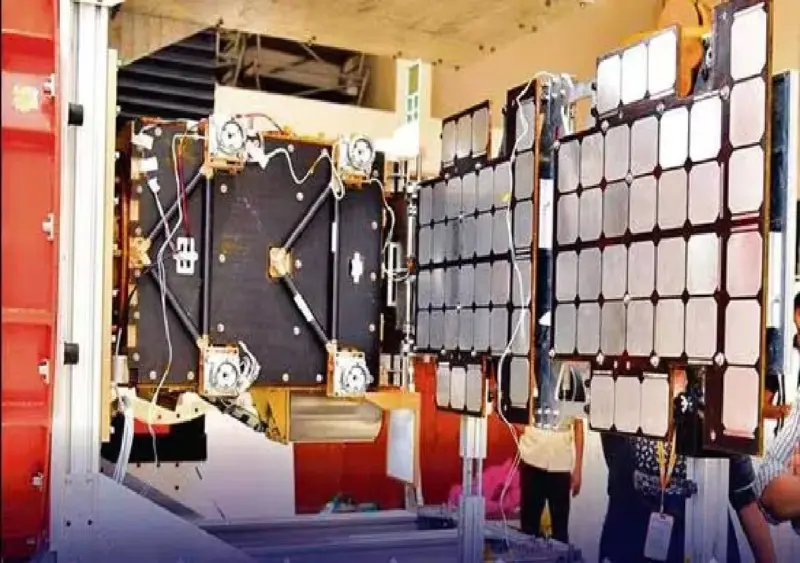

Bengaluru: A private space-tech startup, GalaxEye, is aiming to redefine Earth observation technology with its ambitious satellite Mission Drishti, as India's growing space ecosystem fuels innovation and global competition.
Currently in its final testing phase, the 180-kg satellite is being prepared in a clean room facility before it is transported to ISRO's testing centre for further evaluation. The mission marks a significant milestone as India's first multi-sensor Earth observation satellite developed by a private player.
Mission Drishti combines optical imaging and synthetic aperture radar (SAR) into a single satellite — a capability rarely attempted globally. Traditionally, satellites capture either radar-based data or optical imagery, with companies merging the datasets later through software.
GalaxEye's approach is to integrate both sensors at the source and process the data using artificial intelligence, enabling clearer and more reliable Earth observation even under challenging conditions such as cloud cover or night-time.
The startup has developed an AI platform called SyncFusion, which reconstructs usable images by combining multiple data streams. This technology aims to make satellite data more accessible and understandable, even for non-experts.
Founded in 2021 by a group of graduates from IIT Madras, GalaxEye began operations in a small workspace before scaling up to a 50,000 sq ft facility in Bengaluru's aerospace hub.
The journey, however, has not been without hurdles. Regulatory restrictions on radar testing initially delayed development. The team had to innovate by miniaturising the radar system, eventually testing it on drones to comply with regulations.
This process resulted in one of the lightest multi-sensor satellites globally. At 180 kg, Mission Drishti is significantly lighter than comparable international satellites such as WorldView-3, which weighs around 2,800 kg.
GalaxEye has raised around $14 million across pre-seed, seed and Series A funding rounds. The company has benefited from India's growing focus on space technology, supported by policy reforms and investments.
The government's push, including initiatives like the Indian Space Policy 2023 and the Innovation for Defence Excellence (iDEX) programme, has created opportunities for startups to contribute to sovereign capabilities in space.
Bengaluru's ecosystem, with access to testing facilities, manufacturing hubs and funding networks, has also played a crucial role in the company's growth.
Once launched, likely around mid-2026, Mission Drishti will provide Earth observation data and analytics to a wide range of sectors, including defence, maritime, insurance and disaster management.
The startup plans to expand significantly, aiming to launch 20-25 satellites by 2035 and capture a share of India's growing space market. With an estimated 200-220 satellites expected to be launched by India over the next decade, the opportunity is substantial.
GalaxEye also faces competition from players like Pixxel and ISRO, though its integrated multi-sensor approach sets it apart.
After testing in India, the satellite will be transported to the United States for launch aboard a SpaceX rocket from California. It is expected to be placed in low Earth orbit at an altitude of around 500 km.
However, the stakes remain high. Unlike other tech startups, space ventures have limited room for error. A failed launch could delay the mission by up to two years and significantly impact finances and timelines.
GalaxEye's Mission Drishti reflects the rapid evolution of India's private space sector, blending innovation, engineering and ambition. If successful, it could mark a turning point in how satellite data is captured and used, positioning India as a key player in the global space technology race.