
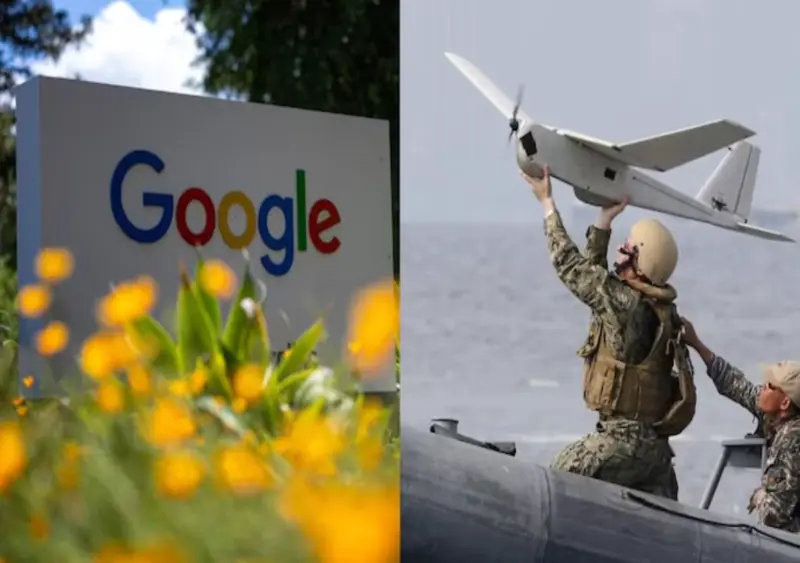

Washington:Google has withdrawn from a $100 million Pentagon challenge aimed at developing advanced AI-powered drone swarms, citing internal concerns over ethics and resource allocation.
The decision underscores ongoing tensions within major technology companies regarding the use of artificial intelligence in military applications.
According to reports, Google initially showed interest in participating in the U.S. Department of Defense's ambitious programme to build autonomous drone systems. However, the company later backed out following an internal ethics review. While official records cited a lack of 'resourcing' as the reason, the decision is widely seen as being influenced by concerns over the ethical implications of deploying AI in warfare.
The move has reportedly created divisions within Google. Some employees involved in the project expressed disappointment at the withdrawal, viewing it as a missed opportunity to contribute to advanced technological development. At the same time, hundreds of AI researchers within the company raised objections to the potential use of Google's cutting-edge technologies in classified military operations.
The Pentagon's initiative aims to revolutionise modern warfare by enabling commanders to control large numbers of drones through simple voice commands. For instance, instructions such as 'left' could be translated into coordinated movements executed by an entire swarm of drones in real time.
The programme is structured as a multi-stage competition over six months, with participating companies working on increasingly complex capabilities. These include improving autonomous navigation, target tracking, information sharing, and complete mission execution from launch to completion.
Several prominent technology firms, including OpenAI, Palantir, and xAI, have been selected to participate in the challenge. Their involvement highlights the growing intersection between artificial intelligence and defence technology.
Anthropic, another major AI company, also engaged with the programme but was not selected for the final stages. The company has previously stated that its participation did not violate its internal policies regarding AI use in military systems.
Google's withdrawal is not an isolated incident. The company has faced similar internal resistance in the past over its involvement in defence-related projects. In 2018, thousands of employees protested against Project Maven, a Pentagon initiative that used AI to analyse drone footage for military purposes.
The backlash eventually led Google to step away from the project and publicly commit to not developing AI technologies for weapons or other harmful applications. This episode marked a turning point in how the company approached defence collaborations.
However, in recent years, Google's stance appears to have evolved. Reports indicate that the company later entered into agreements with the Pentagon allowing its AI technologies to be used for 'any lawful government purpose'. These agreements reportedly do not give Google veto power over how its technologies are deployed, including in classified operations.
A Google spokesperson stated that the company's current approach focuses on providing access to its AI models rather than building customised military solutions. This, according to the company, represents a more 'responsible' way to support national security needs.
The spokesperson also reiterated Google's position that artificial intelligence should not be used for mass surveillance or fully autonomous weapons without meaningful human oversight. This stance reflects broader industry debates about the ethical boundaries of AI deployment.
Despite this, concerns persist within the company. Reports suggest that hundreds of Google AI researchers have urged CEO Sundar Pichai to avoid allowing the company's technologies to be used in classified defence missions. These concerns highlight the ongoing struggle to balance technological innovation with ethical responsibility.
The Pentagon's focus on drone swarms comes amid increasing global reliance on unmanned systems in conflict zones. Recent geopolitical tensions have demonstrated how drones can be used for surveillance, reconnaissance, and targeted operations with significant effectiveness.
AI-powered drone swarms represent the next stage in this evolution, enabling coordinated actions at a scale and speed that would be difficult for human operators alone. However, such advancements also raise serious ethical and legal questions, particularly regarding accountability and the potential for misuse.
Google's decision to withdraw from the programme reflects these broader concerns and signals caution among major technology players when it comes to direct involvement in military AI projects.
Google's exit from the Pentagon's drone swarm challenge highlights the complex and often contentious relationship between Big Tech and defence initiatives. While artificial intelligence continues to play an increasingly critical role in national security, companies face mounting pressure to ensure their technologies are used responsibly.
As debates over ethics, regulation, and innovation continue, the tech industry's role in shaping the future of warfare remains uncertain. Google's decision may not halt the progress of AI in defence, but it underscores the need for clear boundaries and accountability in its development and deployment.