
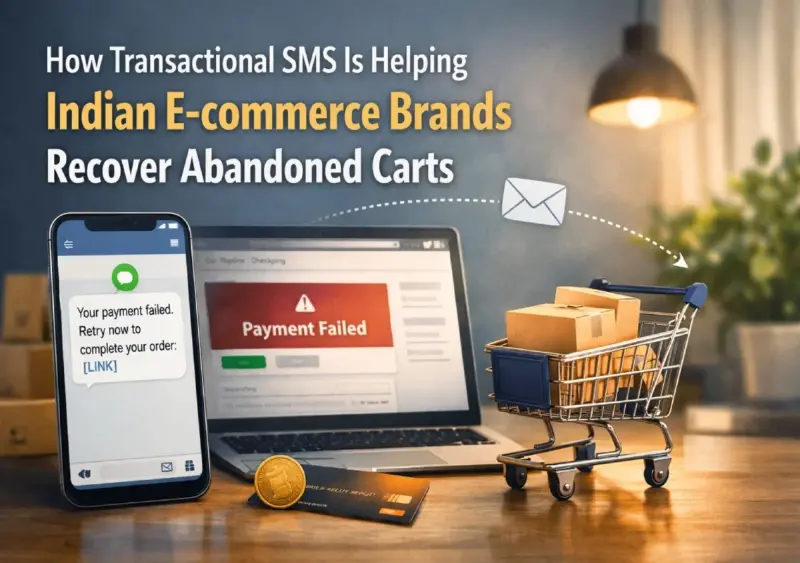

Cart abandonment sits at roughly 70 to 75 percent across Indian e-commerce, according to industry estimates. That means for every ten customers who add a product and begin checkout, seven walk away before paying.
Some change their minds. Many do not - they get distracted, hit a UPI timeout, or find that an OTP never arrived. The intent was there. The sale was not.
Most recovery strategies in use today are either too slow or aimed at the wrong channel. Follow-up emails go out 24 hours later and get buried. Retargeting ads appear days after the customer has already bought from a competitor. What works better, and what a growing number of Indian eCommerce brands are now using, is transactional SMS service.
In which automated event-triggered messages will reach customers within minutes of abandonment on a channel that does not require the internet and carries an open rate close to 98 percent.
This blog breaks down how cart abandonment recovery processes work, what messages perform well, and what compliance requirements businesses need to meet before they can send campaigns.
Why Transactional SMS Works for Indian ECommerce Brands?
Instant Attention:
Email recovery campaigns are standard practice. They are also easy to ignore. An email sent 24 hours after abandonment competes with dozens of other messages in an inbox the customer may not even open that day. But SMS? It's different, it has a whopping open rate of 93% and more, and that too in a few minutes.
Trusted Channel:
SMS is different. People in India have been receiving their most important information - bank alerts, OTPs, delivery updates - by SMS for years. That habit means a message about a pending order gets read in the same way a service notification does. It does not feel like marketing. It feels like information.
Infrastructure:
There is also a practical infrastructure reason. SMS works even without the internet. It also reaches basic handsets. In a country where internet connectivity is still uneven in many areas, that really matters.
Payment failures:
And then there is UPI. Payment failures on UPI are more common than most e-commerce businesses account for - network drops, bank server errors, session timeouts. A lot of what looks like abandoned checkout is actually a failed payment where the customer had every intention of buying. An SMS sent within 45 minutes that says 'your payment did not go through, here is how to retry' is not a reminder. It is a fix..
Key use cases for cart recovery SMS
1. Abandoned cart reminder - nudge to complete purchase.
2. Payment failure alert - show how to retry payment.
3. Low-stock warning - create urgency without being pushy.
4. Coupon or discount reminder - give a small incentive.
5. Assisted checkout offer - provide help via call or chat.
When to send and when to stop
The first SMS should go out within 30 minutes. Purchase intent is at its highest right after abandonment and drops quickly after that.
If the first message does not work, a second follow-up 12 to 24 hours later makes sense - this time with a small incentive, like a coupon.
A third SMS at 48 to 72 hours is the last one worth sending. After that, recovery rates drop sharply and the risk of annoying a potential customer starts outweighing the benefit.
Two to three messages per abandoned cart is the limit. More than that is spam by another name.
Focus on message clarity
Keep each cart abandonment SMS to 1or 2 lines. Use simple language - avoid jargon.
Include customer name, item name, and a clear call to action (CTA) in the message. Add a short link to resume checkout and customer support details.
Example: Hi Rahul, Payment failed for your order of ₹1,299. Try again: short.link/pay or call 080-xxxxxxx for assistance.
Content examples for different customer intents
1. New customer (first purchase): friendly, simple reassurance.
'Hi [Name], complete your 1st order for [Item] - we'll deliver in 3-5 days. Pay here: short.link/first'
2. Returning customer: remind of past value.
'Hi [Name], loved by customers - [Item] still in your cart. Quick pay: short.link/ret'
3. High-value cart: add a human touch.
'Hi [Name], we saved your cart worth ₹100 Call 080-xxxxxxx if you need help finishing.'
Compliance is not optional
Every commercial SMS sent in India - including cart recovery messages - must go through the DLT registration process set by TRAI. This is not a technicality option, but mandatory. Unregistered messages and sender IDs are blocked at the telecom operator level. They never reach the customer.
DLT registration means three things. Registering the business as a Principal Entity, getting the Sender ID approved (the brand name that appears instead of a phone number), and getting each message template pre-approved before use. The annual fee runs around Rs.5,900 on most platforms. Templates take time to get approved, usually a day or two. This cannot be done the night before a campaign launch.
Setting up Transactional SMS
Look for the best bulk SMS providers with a proven record of delivery reliability, fast APIs and clean documentation, detailed reporting, and decent customer support in terms of DLT registration and technicality.
For WooCommerce and Shopify stores, plugins handle most of the integration without custom code. The three triggers to set up are payment failure, checkout started without completion, and cart idle for a defined period.
Custom stores need API integration. It is typically a day's work for a developer - three webhooks, an SMS provider's REST API, and UTM-tagged short links. Not complex, just needs to be set up properly once.
The numbers to watch are recovery rate, conversion rate from SMS link clicks, cost per recovered order, and delivery rate. A delivery rate below 90 percent usually points to a Sender ID problem or a template being partially rejected.
Conclusion
Automated transactional SMS is simple, cost-effective, and powerful for reducing cart abandonment in India. With clear triggers, short templates, and the right provider, you can recover many lost orders. Start small, measure what works, and scale the flow. If you want, I can draft final SMS copies tailored to your product categories and customer segments.