




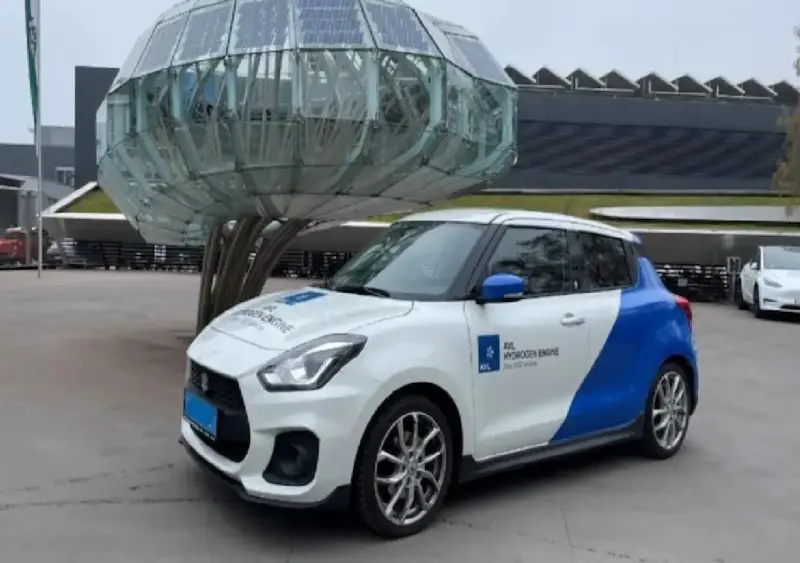

Austrian powertrain specialist AVL Technologies has unveiled a hydrogen-powered prototype of the Suzuki Swift, marking another development in the growing global push towards cleaner automotive technologies and alternative fuel vehicles.
The prototype, showcased as a technology demonstrator, was developed in collaboration with Suzuki and is based on the second-generation Swift hatchback. The project highlights ongoing efforts by automakers and engineering firms to explore hydrogen as a viable clean fuel option for future mobility solutions.
Unlike most hydrogen-powered passenger vehicles currently available in global markets, which use Fuel Cell Electric Vehicle (FCEV) technology, the modified Swift operates using a hydrogen-powered internal combustion engine (ICE).
Industry experts note that while hydrogen combustion engines are generally less efficient compared to fuel-cell systems, they are significantly more economical, practical and easier to integrate into conventional vehicle platforms.
AVL reportedly led the overall development of the project, including engine design, integration, vehicle construction and calibration.
The company equipped the modified Swift with a 1.4-litre direct-injection hydrogen combustion engine that delivers 134 horsepower and 220 Nm of torque.
According to reports, this output represents an improvement of around 13 horsepower and 20 Nm of torque compared to the conventional petrol-powered engine commonly used in the model.
The prototype underwent significant modifications to accommodate hydrogen fuel technology and related components.
Despite the technological achievement, the vehicle is currently intended only as a demonstration model, making the possibility of an immediate commercial launch highly unlikely.
Automotive analysts believe such prototypes primarily serve as research platforms to evaluate the feasibility, performance and future potential of hydrogen-powered mobility solutions.
Hydrogen-powered vehicles have increasingly become part of global discussions on reducing carbon emissions and dependence on fossil fuels.
Most hydrogen vehicles currently use fuel-cell technology, where hydrogen is converted into electricity to power electric motors. However, hydrogen combustion engines represent an alternative approach by adapting conventional internal combustion technology to run on hydrogen fuel.
Supporters of hydrogen-powered mobility argue that the technology can offer fast refuelling times and longer driving ranges compared to battery-electric vehicles, particularly for commercial and long-distance transportation.
At the same time, experts point out that large-scale adoption still faces major challenges, including high production costs, limited hydrogen refuelling infrastructure and the need for clean hydrogen production methods.
The unveiling of the Swift prototype reflects growing experimentation within the automotive sector as manufacturers continue exploring multiple clean-energy pathways.
Union Minister for Road Transport and Highways Nitin Gadkari has consistently advocated hydrogen as a key component of India's future transportation ecosystem.
The minister has repeatedly promoted the use of hydrogen alongside alternative fuels such as ethanol, compressed natural gas (CNG) and electric mobility as part of India's transition towards cleaner transportation.
The Indian government has already initiated pilot projects and policy-level discussions aimed at developing hydrogen infrastructure and encouraging research into hydrogen-powered vehicles.
Gadkari himself has publicly supported hydrogen mobility initiatives and previously used the Toyota Mirai, one of the world's best-known hydrogen-powered vehicles.
Industry observers believe that if automakers such as Suzuki or Maruti Suzuki eventually move towards commercial hydrogen vehicle production, it could significantly boost public awareness and acceptance of the technology in India.
The Suzuki Swift remains one of the most popular hatchbacks in India and several international markets, making it an influential platform for testing emerging technologies.
Experts say that introducing hydrogen technology in a widely recognised model could help accelerate consumer interest in alternative fuel vehicles if infrastructure and affordability challenges are addressed in the future.
However, large-scale adoption of hydrogen vehicles in India is still expected to take several years due to the extensive investment required for production, storage and refuelling infrastructure.
For now, the hydrogen-powered Swift serves as an important demonstration of how traditional internal combustion engines can be adapted for cleaner fuel alternatives while the automotive industry continues its broader transition towards sustainable mobility solutions.