
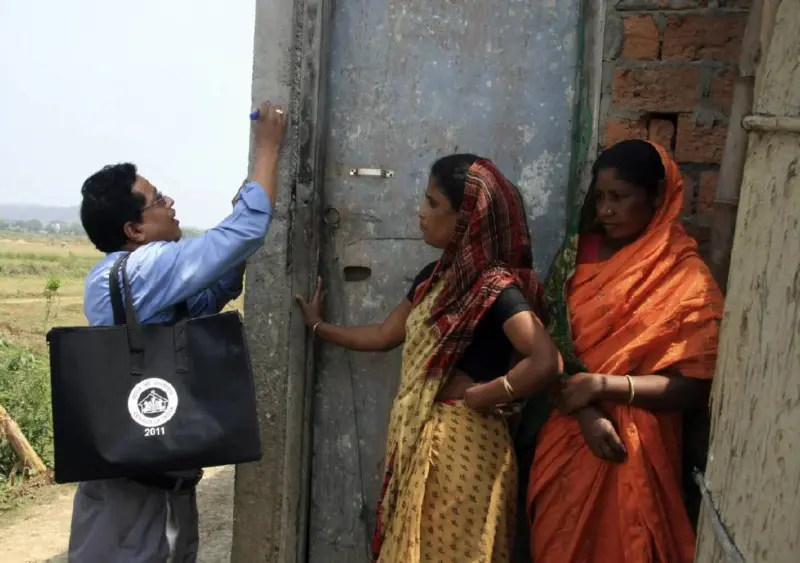

India has begun one of the world's largest administrative exercises—counting its entire population of nearly 140 crore people—in a long-delayed national census that aims to capture the country's evolving social and economic landscape.
The census, originally scheduled for 2021, was postponed due to the Covid-19 pandemic and subsequent administrative challenges. Now underway, the exercise will involve more than 30 lakh enumerators who will go door-to-door across cities, towns and remote villages over the next year.
For the first time in nearly a century, the census will also include caste data, a move that has sparked debate across political and social circles.
India conducts a census once every decade, making this the first in 16 years since the last official count in 2011, when the population stood at just over 120 crore. According to estimates by the United Nations Department of Economic and Social Affairs, India has since surpassed China to become the world's most populous country, with an estimated 140 crore people.
The delay has made this census particularly significant, as it is expected to provide updated insights into population trends, urbanisation, employment, and living standards.
India's demographic profile has also shifted notably. Over 40 per cent of the population is under the age of 25, and the country's median age was estimated at 28 in 2023—considerably younger than many major economies. Economists often describe this as a 'demographic dividend,' which could drive economic growth if supported by employment and policy measures.
The census will be carried out in two phases and will cover all states and Union Territories. In the first phase, officials will collect data on housing conditions, assets, and access to basic amenities such as drinking water, sanitation and cooking fuel.
The second phase, scheduled for February 2027, will gather detailed demographic data, including age, education, occupation, income, migration patterns and fertility rates.
Enumerators—primarily schoolteachers and government officials—will visit approximately 6.4 lakh villages and 10,000 towns to collect data. In a significant technological shift, the information will be recorded digitally through a mobile application for the first time, replacing traditional paper-based methods.
The questionnaire has expanded considerably over time. When the first comprehensive census was conducted in 1872 during British rule, it included only 17 basic questions. In contrast, the upcoming exercise will include 33 questions in the first phase alone.
Authorities aim to assess not just population numbers but also living conditions. Households will be asked about ownership status, construction materials, and access to modern amenities. Questions will also cover digital connectivity, including internet access, smartphones, televisions and vehicles.
This broader data collection is expected to provide a clearer picture of inequalities and development gaps across regions.
One of the most debated aspects of this census is the inclusion of caste data for the first time since 1931. The caste system, a centuries-old social hierarchy, continues to influence various aspects of life in India, including access to education, employment and social mobility.
Supporters argue that collecting caste data is essential for designing welfare policies and ensuring equitable distribution of resources, especially for historically marginalised communities. It also plays a role in implementing reservation policies in government jobs and educational institutions.
However, critics contend that reintroducing caste enumeration could reinforce social divisions at a time when the country is striving for greater unity and equality.
Beyond numbers, the census is a vital tool for governance and policy-making. It helps the government allocate resources, plan infrastructure, design welfare schemes and determine political representation.
In a country as vast and diverse as India, accurate and updated data is critical to addressing challenges such as poverty, unemployment, healthcare access and education gaps.
With rapid urbanisation and technological growth, the upcoming census is expected to reflect the changing realities of Indian society, from rising digital adoption to shifting migration patterns.
As India undertakes this massive counting exercise, the census is set to shape the country's policy direction for the next decade. While debates around caste and data privacy continue, the exercise remains essential for understanding the needs of 140 crore people.
The scale, complexity and ambition of the census underline its importance—not just as a statistical exercise, but as a mirror reflecting the nation's social and economic transformation.