




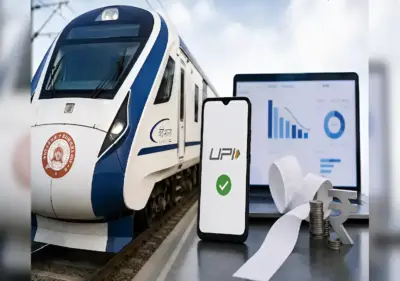

New Delhi: Indian Railway Catering and Tourism Corporation (IRCTC) is facing growing pressure on its internet ticketing business as passengers increasingly choose UPI payments, which carry lower convenience fees than card and credit-line transactions.
The issue came into focus during the company’s Q1 FY27 earnings call, as a Parliamentary panel separately pushes for a calibrated Merchant Discount Rate (MDR) on high-value UPI transactions.
IRCTC chairman and managing director Rahul Himalian said UPI’s share of ticket bookings had risen to 51.22%, compared with 48.72% a year earlier. While the increasing use of UPI reflects the payment method’s growing popularity, it is also putting pressure on the company’s convenience fee income.
UPI growth weighs on convenience fee income
During the earnings call, an analyst pointed out that IRCTC’s internet ticketing revenue had remained largely stagnant for eight quarters despite increasing passenger numbers and a growing number of trains.
Himalian acknowledged the pressure and linked it partly to the growing use of UPI.
He explained that the company charges different convenience fees depending on the payment method, with UPI transactions attracting lower charges than payments made through cards and credit lines.
The IRCTC chief said the increasing share of UPI payments was affecting profitability and indicated that the company would need to consider how to address the issue.
IRCTC earns Rs 248 crore in convenience fees
IRCTC earned Rs 248 crore in convenience fees during the quarter from 13.27 crore tickets, translating into an average of roughly Rs 19 per ticket.
According to the company’s disclosed fee structure, UPI transactions attract convenience fees of around Rs 10-20, while card and credit-line payments can attract fees ranging from Rs 15-30.
The difference means that a passenger choosing UPI can generate a lower convenience fee for IRCTC than one paying through a card or credit line.
An illustrative calculation based on the company’s disclosed figures suggests that the increasing shift towards UPI could result in several crore rupees in lower fee income. However, this is an estimate based on the available numbers and is not a loss figure disclosed by IRCTC.
UPI share crosses the halfway mark
The rise in UPI’s share is significant because it has now crossed the halfway point of IRCTC’s ticket bookings.
UPI accounted for 51.22% of bookings in the latest quarter, compared with 48.72% a year earlier. The growing preference reflects the widespread adoption of instant digital payments in India.
For consumers, UPI offers convenience and generally avoids the additional costs associated with certain card-based transactions. For IRCTC, however, the increasing use of the payment method creates a mismatch between rising transaction volumes and convenience fee growth.
This has become particularly relevant as the company seeks to maintain profitability in its internet ticketing business.
Internet ticketing margin declines
The impact is also visible in IRCTC’s internet ticketing profitability.
The segment’s EBIT margin declined to 80.33%, compared with 84.12% a year earlier. Based on the segment’s revenue base of around Rs 361 crore, the decline represents a substantial reduction in operating profit.
The company has also seen convenience fee growth slow, with the quarterly increase reported at 4.89%.
The subdued growth has raised questions about whether the existing fee structure can keep pace with rising costs and changing payment preferences.
Company differentiates payment fees
IRCTC has already introduced a strategy aimed at managing the impact of different payment methods.
The company charges higher convenience fees for certain credit card and credit-line transactions compared with UPI payments. This approach allows IRCTC to partially offset the lower revenue generated by UPI transactions.
Himalian indicated that the company was attempting to address the issue through this differentiated fee structure rather than waiting for a broader change in UPI pricing policy.
However, management has acknowledged that the scope for changing convenience fees is also linked to policy decisions.
Parliamentary panel seeks calibrated MDR
The issue extends beyond IRCTC and forms part of a larger national debate over the economics of UPI payments.
A Standing Committee on Finance headed by Bhartruhari Mahtab has highlighted the financial burden associated with maintaining zero-MDR transactions. The panel has noted that the Centre’s Rs 2,000-crore allocation to compensate for zero-MDR transactions covers only a portion of the industry’s estimated Rs 20,700-crore operational cost.
The committee has called for an expeditious and calibrated MDR on high-value transactions as a possible way to address the gap.
The proposal has significant implications for India’s digital payments ecosystem, where UPI has become a dominant mode of transaction.
IRCTC offers a real-world example
IRCTC’s latest earnings call provides a direct example of the broader issue highlighted by the Parliamentary panel.
As more passengers choose UPI for ticket payments, the company receives lower convenience fees compared with some other payment methods. At the same time, passenger volumes and digital transactions continue to rise.
The situation illustrates the question at the heart of the MDR debate: who should ultimately bear the cost of maintaining a widely used payment system when consumers are not charged directly for the transaction?
For IRCTC, the immediate response has been to differentiate convenience fees by payment method. However, the company has indicated that the broader question depends partly on policy decisions.
As UPI continues to expand across India’s digital economy, the experience of IRCTC shows how the zero-MDR model can create financial pressures even for large platforms handling millions of transactions. The debate over whether and how high-value UPI transactions should attract MDR could therefore have implications well beyond the railway ticketing sector.