
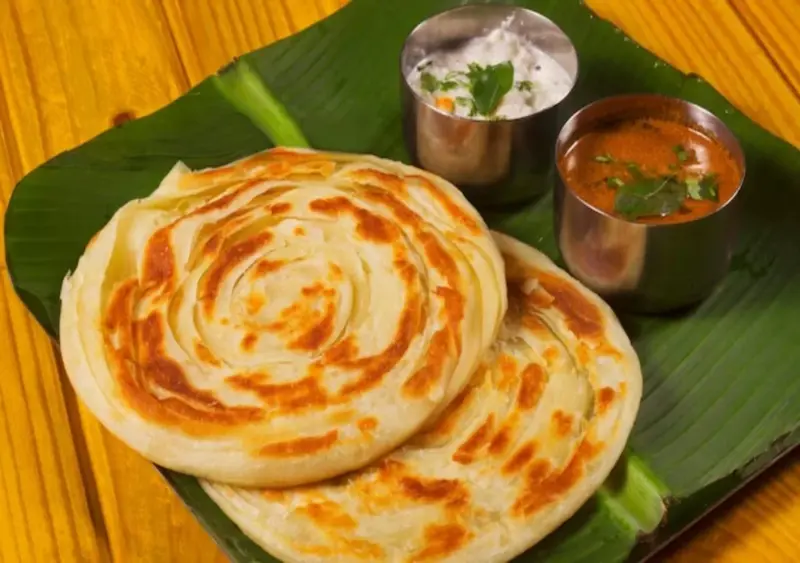

Kozhikode: The beloved Malabar parotta, often considered a culinary symbol of Kerala, may not actually have originated in the state. Despite its deep association with the Malabar region, food historians and culinary experts suggest that the flaky, layered bread has a far more complex and global history.
From bustling thattukadas (street-side eateries) in Kerala to restaurant menus across India and Southeast Asia, Malabar parotta has earned its place as a staple comfort food. However, beneath its crispy layers lies a story shaped by migration, trade and cultural exchange rather than a single point of origin.
Malabar parotta is widely enjoyed with rich curries such as beef fry, chicken curry and fish gravy, making it a staple across Kerala's food culture. Its soft, flaky texture and layered structure distinguish it from other Indian breads.
However, experts point out that one key ingredient raises questions about its origin — maida (refined wheat flour). Kerala is not traditionally a wheat-growing region, leading to speculation that the dish may have been introduced from elsewhere.
Over time, the parotta became closely associated with the Malabar region, not necessarily because it originated there, but because it gained immense popularity in local street food circuits.
One of the most widely accepted theories links Malabar parotta to Sri Lanka. According to food writer Krish Ashok, the origins can be traced back to Jaffna in northern Sri Lanka.
During the 1940s, the Travancore region in Kerala faced a severe famine. Fishermen travelling between Kerala and Jaffna are believed to have encountered a similar layered flatbread known as veechu parotta. Around the same time, British colonial policies promoted wheat consumption, increasing the availability of refined flour.
Sailors and traders are said to have brought the recipe back to Kerala, where it quickly became popular in roadside eateries. Over time, it evolved into what is now known as Malabar parotta.
Another theory places the origins even earlier, linking the dish to Arab traders who frequented the Malabar coast through ancient maritime trade routes.
Culinary anthropologist Kurush Dalal suggests that the technique of making laminated, layered flatbreads may have been introduced by traders from West Asia. These methods could have travelled across regions, eventually influencing similar breads in Sri Lanka and southern India.
If this theory holds true, the Malabar parotta may be part of a much older culinary exchange network shaped by centuries of trade and cultural interaction.
A less widely accepted theory connects Malabar parotta to North India's lachha paratha. Both breads share similarities in their flaky, layered texture, leading some to believe that the dish may have travelled south over time.
This migration could have occurred during the British-era Madras Presidency, when movement of people and culinary practices was common. However, experts consider this theory less credible due to differences in preparation techniques and regional contexts.
6
The journey of this layered bread did not stop in Kerala. Variants of parotta spread to Southeast Asia, where it evolved into dishes like roti canai in Malaysia and roti prata in Singapore.
Today, these versions are widely consumed and adapted with local flavours, reflecting the dish's remarkable ability to transcend borders and cultures.
Despite multiple theories, there is no definitive answer to where Malabar parotta truly originated. The lack of documented history makes it difficult to pinpoint a single source.
What is clear, however, is that the dish is a product of cultural exchange — shaped by trade, migration and adaptation over decades, if not centuries.
Regardless of its origins, Malabar parotta remains deeply embedded in Kerala's culinary identity. Its popularity continues to thrive not just in India but across the world, proving that food often belongs less to geography and more to shared human experience.