




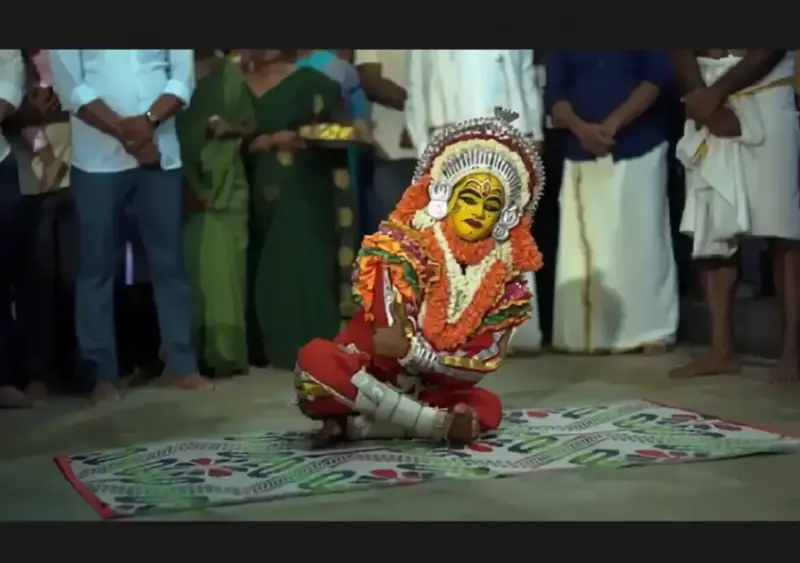

Mangaluru: A controversy has erupted in coastal Karnataka after allegations surfaced that a person from the Christian community performed a ritual dance during a Nema ceremony, reportedly violating long-standing customs associated with Daivaradhane in the Tulunadu region.
Daivaradhane, also known as spirit worship, is an important cultural and religious tradition practised across Dakshina Kannada and Udupi districts. Rituals such as Nema and Kola form a central part of this tradition, where designated ritual performers known as Daiva Nartakas enact sacred dances believed to invoke the presence of local spirits or deities.
While the rituals involve the participation of nearly 16 communities in various roles, tradition prescribes that the actual ritual dance must be performed only by members of three specific communities — Pambada, Parava and Nalike.
The recent incident has sparked debate in the region, with questions being raised about adherence to customary practices and the interpretation of community identity within traditional systems.
The controversy relates to a Nema ritual reportedly held recently at a Daivasthana in Bolur in Mangaluru.
According to available information, the temple's administrative committee had assigned the responsibility of conducting this year's ritual to Ganesh Pambada of Chipparu Bayar in Kasaragod.
However, objections surfaced later after it was alleged that the ritual dance was performed by the son of the late Ganesh Pambada of Padavinangady. The issue arose because the performer was reportedly born to a Christian mother.
This led to concerns among members of the Pambada community and observers of Daivaradhane traditions, as ritual performers are traditionally expected to belong to the communities historically associated with the role of Daiva Nartakas.
The matter soon gained attention locally, prompting discussions about whether the performance adhered to established customs.
Members of the Pambada community follow a matrilineal social system known as Aliyakattu, under which community identity is determined through the mother's lineage rather than the father's.
Based on this traditional framework, critics argue that despite being the biological son of the late Ganesh Pambada, the performer cannot be considered part of the Pambada community because his mother belongs to the Christian community.
As a result, some community members claim that the participation of the individual in the ritual dance could be seen as a deviation from customary norms.
Supporters of strict adherence to tradition maintain that Daiva Nartana is not merely a performance but a sacred responsibility tied to hereditary roles passed down within specific communities over generations.
Dr Rathi, a researcher from the Pambada community, has publicly raised objections regarding the incident.
According to her, she became aware of the matter only after the ritual had taken place. She alleged that she faced insults when she questioned the issue and demanded clarification regarding the performer's eligibility to carry out the ritual.
Dr Rathi has further stated that individuals who do not meet traditional community criteria should not be permitted to perform Daiva Nartana in the future.
She has also demanded that the person involved seek forgiveness before the deity for what she described as a violation of long-standing customs. In addition, she warned that she is prepared to pursue legal action if necessary until the issue is addressed and resolved.
The incident has triggered a broader discussion in coastal Karnataka about the intersection of tradition, community identity and evolving social realities.
Daivaradhane is deeply rooted in the cultural heritage of Tulunadu, with rituals like Nema and Kola drawing large numbers of devotees and observers each year. The rituals are often seen not only as religious ceremonies but also as a reflection of the region's historical social structure.
At the same time, modern legal and social frameworks sometimes intersect with customary practices, creating debates over how traditions should adapt or be preserved.
Observers say the outcome of the current controversy could influence future discussions about ritual roles and eligibility in Daivaradhane ceremonies.
For now, the issue remains under discussion within the community and among temple authorities. Whether the matter leads to formal action or legal proceedings remains to be seen.
As Daivaradhane continues to hold strong emotional and cultural significance in Tulunadu, many in the region are closely watching how the controversy unfolds and whether it results in clearer guidelines regarding traditional ritual roles.