
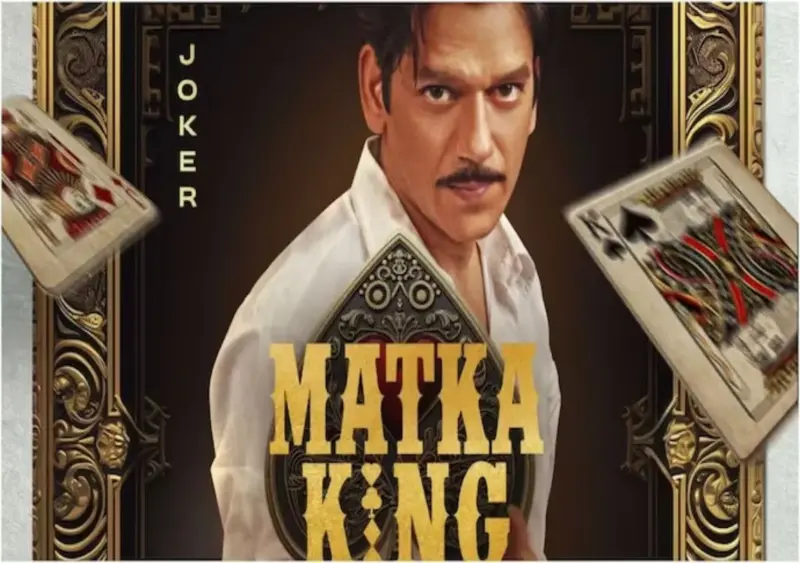

Mumbai:Matka King, directed by Nagraj Manjule, is an ambitious dive into the world of gambling, morality, and survival in 1960s-70s Bombay.
Led by a riveting performance from Vijay Varma, the Prime Video series attempts to balance character study with socio-economic commentary. While it succeeds in parts, it does not entirely deliver the knockout impact its premise promises.
The series opens with a striking visual—two policemen placing bets on whether a severely injured man will live or die. This unsettling moment sets the tone for what follows: a world where life itself is reduced to chance. From there, the narrative travels back 11 years to introduce Brij Bhatti, played with finesse by Vijay Varma.
Brij is a mill worker who also manages gambling operations for Lalji, portrayed by Gulshan Grover. Living in poverty with mounting family pressures, including a reckless brother and financial instability, Brij is constantly navigating survival. His circumstances make him both vulnerable and ambitious, a duality that becomes central to the story.
The invention of 'matka' becomes his turning point. What begins as an opportunity soon evolves into a thriving gambling enterprise. Brij's innovation lies in making the game accessible and enticing, drawing people from various walks of life. However, what distinguishes him is his unusual moral code—he refuses to cheat.
Brij Bhatti is not a conventional anti-hero. He profits from people's losses, yet holds on to a sense of integrity in a dishonest world. This contradiction forms the backbone of the narrative. Even as his influence grows, Brij resists external pressures, including involvement in cricket betting and demands from underworld figures.
A character loosely reminiscent of figures like Dawood Ibrahim is introduced but fails to leave a lasting impression. Despite these distractions, Brij's journey remains engaging, largely due to the layered writing and Varma's compelling performance.
The show also explores the cost of success. As Brij climbs the ladder, he becomes emotionally distant from his wife, played by Sai Tamhankar, and sends his son away. His personal sacrifices underline the emotional toll of ambition, adding depth to his character.
One of the show's highlights is the relationship between Brij and Gulrukh, a Parsi widow played by Kritika Kamra. Believing herself to be unlucky, Gulrukh forms a bond with Brij that is both tender and complex. Their connection brings a softer, more introspective layer to the otherwise gritty narrative.
Sai Tamhankar delivers a restrained yet powerful performance as Brij's wife, embodying quiet resilience. Meanwhile, the supporting cast—including Siddharth Jadhav, Jamie Lever, and Gulshan Grover—adds texture to the story without overshadowing the central plot.
A particularly memorable scene involves two women choosing empathy over rivalry, offering a refreshing departure from stereotypical portrayals. Such moments elevate the narrative, even if they are few and far between.
The recreation of old Bombay is immersive and detailed without feeling overdone. From references to Saira Banu to the inclusion of songs like Badan Pe Sitaare, the show captures the era's essence effectively.
A quirky yet impactful scene features a pilot announcing matka numbers mid-flight, symbolising the widespread reach of Brij's enterprise. Additionally, the series touches upon media dynamics, highlighting how sensationalism often takes precedence over meaningful journalism—a theme that remains relevant even today.
Vijay Varma is undoubtedly the backbone of Matka King. He seamlessly transitions between Brij's multiple shades—ambitious, vulnerable, and morally conflicted. His performance alone keeps the series engaging.
However, the show struggles with pacing. At eight episodes, it feels stretched, with certain segments—especially those explaining gambling mechanics—becoming overly detailed. For viewers unfamiliar with or uninterested in betting, these portions may feel tedious and disrupt narrative flow.
Kritika Kamra, despite her strong screen presence, is underutilised, while some subplots fail to leave a lasting impact. These inconsistencies prevent the series from achieving its full potential.
At its core, Matka King is about hope—the belief that the next bet might change one's destiny. This idea resonates throughout the series, driving both the characters and the narrative.
While the show does not fully capitalise on its strong premise, it remains compelling enough to hold attention. The mix of moral dilemmas, emotional arcs, and socio-economic commentary ensures that it never becomes entirely uninteresting.
Matka King may not hit the jackpot, but it is far from a losing bet. With a standout performance by Vijay Varma and a thoughtfully constructed world, the series offers moments of brilliance. However, uneven pacing and underdeveloped subplots hold it back from greatness.