
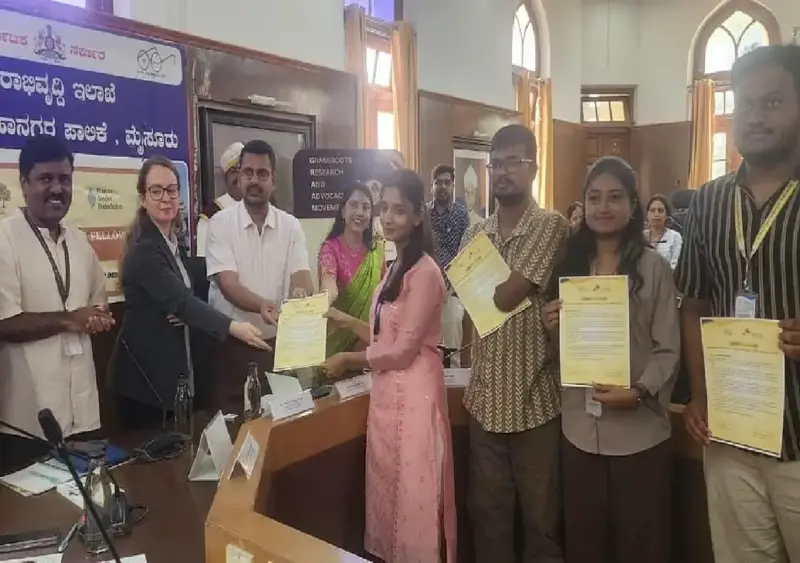

Mysuru: Emphasising that rapid urban transformation requires more than financial resources, Mysuru City Corporation (MCC) Commissioner Shaik Tanveer Asif has called for a shift towards 'Design Thinking' in urban administration, stressing the need for more people-centric and practical governance models.
He was speaking at the inauguration of the fifth cohort of the Youth Governance Fellowship (Y4G), organised by the Grassroots Research and Advocacy Movement in partnership with the Hanns Seidel Foundation.
Highlighting key priorities for modern cities, Asif said affordability and sustainability must serve as the twin pillars of urban development. He noted that while cities are expanding rapidly, planning must remain inclusive and responsive to citizens' real needs.
He pointed out that urban challenges are becoming increasingly complex, requiring innovative approaches rather than conventional administrative methods.
The commissioner observed that Urban Local Bodies (ULBs) like Mysuru have witnessed increased financial devolution in recent years. However, he cautioned that the mere availability of funds does not guarantee progress.
'The bottleneck today is not just money; it is effective utilisation, meticulous planning, and robust execution,' he said.
Asif advocated adopting a 'Design Thinking' framework—a methodology that prioritises the lived experiences of citizens—to address everyday urban challenges. He emphasised the importance of solving 'ground-level friction' in areas such as parking management, regulation of street vending, and improving urban mobility.
He further stressed that urban solutions must not only be innovative but also administratively viable and socially inclusive. According to him, governance should move beyond theoretical planning and focus on tangible outcomes that directly benefit residents.
Executive Director of GRAAM, Basavaraju R Shreshta, highlighted the issue of limited youth participation in formal governance systems. He stated that the responsibility for this gap lies not only with young people but also with institutions.
'It is the collective responsibility of the government and civil society to create platforms where meaningful engagement is possible,' he said.
Resident representative of the Hanns Seidel Foundation in India, Judith Weinberger-Singh, reaffirmed the organisation's commitment to decentralised governance. She noted that partnerships between civil society, academia, and government institutions are crucial for building inclusive communities.
MCC Additional Commissioner B N Veena encouraged fellows to work closely with various government departments, emphasising that such collaboration would help make governance more responsive and citizen-focused, especially in a heritage city like Mysuru.
The inaugural programme was attended by several experts and academicians, including Professor H P Jyothi from the Department of Social Work at the University of Mysore, advocate Tejaswini Bhat, Professor M Shivaprasad from Teresian College, GRAAM Head of Projects Mallikarjuna Swamy, and Project Coordinator Pavan.
The call for adopting 'Design Thinking' reflects a growing recognition that effective urban governance must centre around people's needs. As cities like Mysuru continue to expand, integrating innovative and inclusive approaches could play a crucial role in shaping sustainable and liveable urban spaces.