


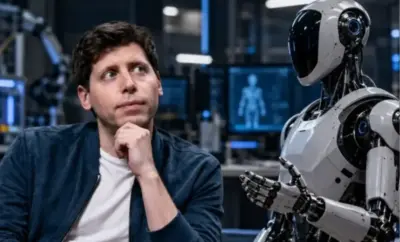

OpenAI is expanding its ambitions beyond artificial intelligence models and into humanoid robotics, with CEO Sam Altman indicating that the company could showcase a demonstration of its robot in 2027. The announcement signals the company's interest in developing machines capable of interacting with the physical world, although commercially available humanoid robots may still be several years away.
Speaking on the Sources podcast, Altman discussed why a human-like design could be useful for robots operating in environments built around people. He also told Fortune that he expected OpenAI to have a demonstration worth showing in 2027, while cautioning that humanoid robots would not become a common sight on streets in the immediate future.
OpenAI has not revealed the robot’s appearance, capabilities, technical specifications or a potential launch date. Altman suggested that the artificial intelligence powering the machine would be more important than its physical design, highlighting the challenge of developing systems that can understand their surroundings and perform tasks reliably.
The company’s reported preparations for robotics development, including a dedicated research effort and recruitment across technical areas, indicate that it is exploring how its AI expertise could be applied to physical machines.
Sam Altman points to a 2027 humanoid robot demo
Altman’s comments offer an indication of OpenAI’s possible timeline for demonstrating its humanoid robotics work.
“I think we’ll have a cool demo in 2027," he told Fortune, according to the report. However, he also suggested that widespread adoption would take longer, saying he did not expect robots to be walking the streets for a few more years.
The distinction between a demonstration and a commercial product is important. A prototype can showcase selected capabilities under controlled conditions, while a commercially viable humanoid must perform consistently, operate safely and handle a wide range of tasks in real-world environments.
OpenAI has not announced whether its proposed demonstration will feature a fully autonomous humanoid, a research prototype or a machine designed for specific tasks. Details about its mobility, dexterity, battery life and intended applications also remain undisclosed.
Altman’s remarks suggest that the company is still working towards a demonstrable system rather than preparing to release a finished consumer robot.
Why does OpenAI want to build a humanoid robot?
One reason for developing a human-like robot is that much of the physical world has been designed around the human body.
“We live in a world that is very much designed for people,” Altman said during the discussion. “Matching that form factor seems good.”
Buildings, workplaces and homes contain objects designed for people to use, including doors, handles, stairs, tools and household equipment. A robot with a human-like body could potentially navigate these environments and operate existing equipment without requiring every space to be redesigned.
Humanoid robots typically feature a combination of a torso, arms, hands and legs, although their exact configurations differ between manufacturers. The design can offer flexibility across tasks, but it also introduces engineering challenges involving balance, movement, coordination and safety.
A robot that can walk like a person must maintain stability while moving across different surfaces. A machine designed to manipulate objects must also coordinate its hands and fingers with information gathered from cameras and other sensors.
These tasks require more than mechanical components. The robot needs software that can interpret its surroundings, decide what action to take and adjust its movements when conditions change.
For OpenAI, the opportunity lies in combining its AI research with the hardware and control systems needed to operate in physical environments.
The AI brain could be more important than the design
Altman indicated that the intelligence powering a humanoid robot would be more significant than the details of its external design.
A humanoid machine needs to process information from cameras and sensors, identify objects, understand instructions and plan movements. It must then translate those decisions into coordinated physical actions.
For example, picking up a cup requires a robot to recognise the object, estimate its position, move its arm towards it, adjust its fingers and apply enough force to hold it without dropping or damaging it.
More complex tasks require a system to combine several actions, respond to unexpected changes and learn how to operate in unfamiliar surroundings.
AI models could help robots interpret instructions and plan tasks, but reliable physical performance also depends on motion-control software, sensors, mechanical engineering and extensive testing.
A model that performs well in a digital environment may not automatically succeed when controlling a physical machine. Real-world systems must contend with friction, changing lighting, unpredictable obstacles and objects that behave differently from their digital representations.
This is one reason robotics development requires close collaboration between AI researchers and engineers working on hardware, movement and system integration.
OpenAI’s earlier robotics research
OpenAI has previously explored the use of AI in robotic systems.
One of its best-known research efforts was Dactyl, a project that trained a robotic hand to manipulate physical objects using techniques developed through simulation. The system demonstrated that simulated training could help a robot perform certain complex movements in the real world.
OpenAI later applied related techniques to a robotic hand that manipulated a Rubik’s Cube. The research highlighted the potential for AI systems to learn physical tasks through repeated training rather than relying entirely on manually programmed movements.
These experiments did not amount to a general-purpose humanoid robot, but they provided experience in connecting AI systems with physical actions.
The company’s current reported robotics recruitment suggests a broader effort to develop the technology needed for more capable machines. Its vacancies reportedly cover areas such as motion control, whole-robot behaviour, manufacturing and supply-chain operations.
Such roles point to the range of challenges involved in moving from research prototypes to hardware that can be produced and deployed at scale. However, job listings alone do not establish how advanced OpenAI’s humanoid project is or how soon a finished product could become available.
Tesla and Chinese companies intensify competition
OpenAI would enter a field in which several technology companies are already developing humanoid robots.
Tesla has been working on its Optimus robot, which is intended to perform physical tasks and could eventually be used in manufacturing and other environments. The project forms part of the company’s wider ambitions around artificial intelligence, automation and robotics.
Chinese companies have also made advances in the sector. Unitree has attracted attention for its humanoid robots and demonstrations of increasingly dynamic movement, including running. Xpeng has showcased its IRON humanoid robot and reported progress towards automated production of humanoid machines.
These developments reflect a broader effort to build robots that can move beyond carefully controlled laboratory demonstrations and perform useful work in factories, warehouses and potentially homes.
However, comparing robots based on demonstrations alone can be difficult. Running speed, walking ability and visually impressive movements do not necessarily establish whether a machine can perform useful tasks safely and reliably over extended periods.
Manufacturers must also address production costs, maintenance, energy consumption, durability and the ability to operate around people.
For OpenAI, entering the sector would mean competing not only on the intelligence of its AI models but also on mechanical design, hardware reliability and practical performance.
Humanoid robots are still years away from widespread use
Despite rapid progress, humanoid robots face substantial barriers before they can become commonplace.
One challenge is dexterity. Human hands can perform a wide variety of tasks using subtle movements and feedback, while robotic hands must reproduce similar capabilities through motors, sensors and software.
Mobility presents another challenge. Walking across uneven ground, navigating crowded spaces and recovering from unexpected disturbances require sophisticated control systems. Safety becomes especially important when robots operate near people.
Cost is also a major consideration. Even a capable prototype may be too expensive or difficult to maintain for widespread commercial use. Manufacturers need to demonstrate that robots can perform useful work at a cost that justifies their deployment.
Finally, general-purpose robots must deal with unpredictable environments. A machine that performs a task successfully in a factory demonstration may struggle when confronted with unfamiliar objects or changing conditions.
Altman’s comments indicate that OpenAI does not expect humanoids to become a routine part of everyday life immediately. A demonstration in 2027, if delivered as anticipated, would provide a clearer picture of the company’s approach and technical progress.
OpenAI’s hardware ambitions extend beyond robotics
The humanoid project would add another dimension to OpenAI’s efforts to bring AI into everyday life. The company is best known for its AI models and software products, but reports have also pointed to plans for physical devices, including a possible smart speaker.
A move into hardware could allow AI systems to interact with users beyond computers and smartphones. Humanoid robots would represent a more ambitious step because they would need to perceive and act within the physical world rather than simply respond to digital inputs.
For now, OpenAI has not provided detailed specifications or a confirmed commercial release schedule for its humanoid robot. The proposed 2027 demonstration remains the clearest timeline indicated by Altman’s remarks.
If the company can combine capable AI with reliable movement and practical hardware, it could become a significant participant in the humanoid robotics race. Whether that progress leads to useful, affordable robots for businesses and households will depend on what the technology can demonstrate beyond a staged presentation.