
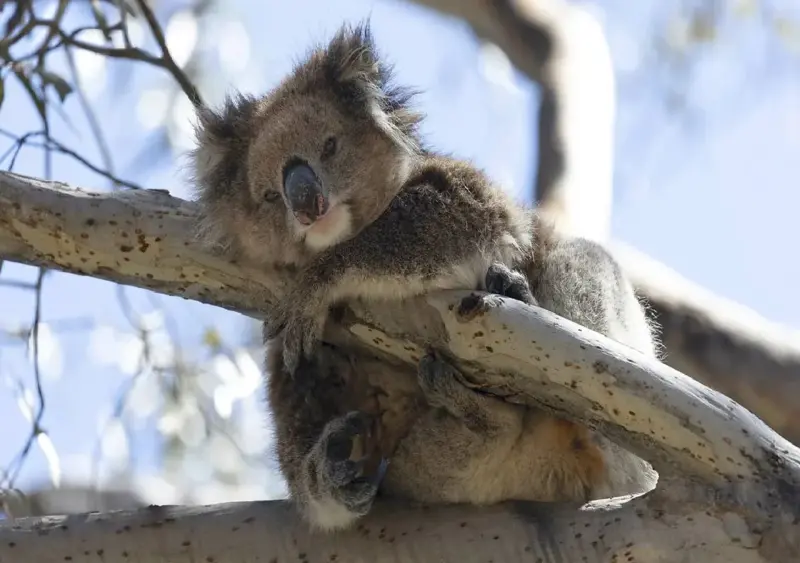

Australia: A disease-free island off the coast of South Australia is emerging as a crucial lifeline for koalas, as scientists work urgently to protect the species from a deadly mix of disease and genetic decline.
In a recent field operation near Belair National Park, researchers carefully captured and examined koalas as part of an ongoing conservation effort. Armed with long poles and following well-practised techniques, experts safely brought down a female koala from a tree for a routine health check.
What they found highlights the growing crisis facing the species.
According to researchers, chlamydia has become one of the most serious threats to koala populations across mainland Australia. Caused by the bacterium Chlamydia pecorum, the disease can lead to blindness, infertility, pneumonia and often death.
Scientists estimate that in some mainland populations, up to 88 per cent of koalas are affected. Unlike in humans, where the infection is rarely fatal, the disease is devastating for koalas and has significantly contributed to their population decline.
Karen Burke Da Silva, a conservation biologist at Flinders University, suspects that the captured koala from Belair National Park may also be infected.
Researchers have been monitoring around 40 koalas in the park, tracking both their health and genetic patterns to better understand the spread and impact of the disease.
Just off the mainland lies Kangaroo Island, home to what is believed to be the world's largest chlamydia-free koala population. This island has effectively acted as a natural quarantine zone, shielding its koalas from the widespread infection seen elsewhere.
Because of this, scientists consider the island population a vital 'insurance policy' for the species' survival. These healthy koalas could potentially be used to repopulate affected regions in the future. However, this refuge comes with a significant drawback.
The koalas on Kangaroo Island have been isolated for more than a century. While this isolation has protected them from disease, it has also led to a severe lack of genetic diversity.
This phenomenon, known as a genetic bottleneck, makes the population more vulnerable to environmental changes, diseases, and reduced fertility over time.
Researchers such as Julian Beaman are studying ways to increase genetic diversity among these koalas. The plan involves carefully introducing new genetic material into the island population and later relocating some individuals to low-risk areas on the mainland.
Such interventions must be handled cautiously to avoid introducing diseases like chlamydia to the currently healthy population.
Koalas, native to eastern and southeastern Australia, are currently listed as vulnerable by global conservation authorities. While overall population estimates range between 3.98 lakh and 5.69 lakh, their numbers have been steadily declining.
The primary reason is habitat fragmentation. Urban expansion, deforestation, and climate change have broken koala populations into smaller, isolated groups. This isolation increases inbreeding and reduces their ability to adapt to environmental changes.
Experts warn that these combined pressures could lead to gradual local extinctions.
'In each of those pockets, you get inbreeding and random population fluctuations that raise the risk each one will go extinct,' Beaman noted. 'If we're not careful, it will be death by a thousand cuts.'
Scientists now face the dual challenge of controlling the spread of disease on the mainland while improving genetic diversity in isolated populations like those on Kangaroo Island.
Efforts include health monitoring, controlled breeding programmes, and potential relocation strategies aimed at strengthening the species' long-term survival.
The plight of koalas highlights the complex challenges of wildlife conservation in the modern era. While Kangaroo Island offers hope as a disease-free sanctuary, its genetic limitations underscore the delicate balance required in conservation strategies.
With coordinated scientific efforts and timely intervention, experts believe it is still possible to reverse the decline. However, the window for action is narrowing, making this a critical moment for one of Australia's most iconic species.