
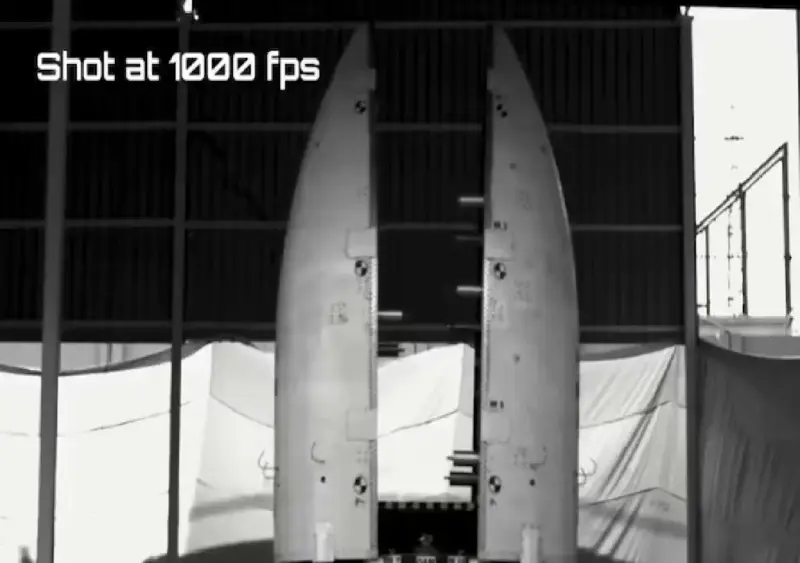

Hyderabad/Sriharikota: India's private space sector achieved a significant milestone on April 8, as Skyroot Aerospace successfully completed the final pre-flight payload fairing separation test for its Vikram-1 rocket, bringing it closer to its maiden orbital launch.
The successful test confirms that the rocket can safely deploy satellites into orbit, marking one of the last critical checks before launch.
The payload fairing, often referred to as the rocket's nose cone, plays a vital role during launch. It protects satellites from extreme heat, pressure, and vibrations as the rocket ascends through Earth's atmosphere.
Once the rocket reaches space, the fairing must split into two halves and detach cleanly to allow satellite deployment.
Skyroot tested this mechanism using a pneumatic system powered by air pressure on actual flight hardware. High-speed footage captured at 10,000 frames per second showed the fairing separating smoothly and precisely, demonstrating the reliability of the system.
The company confirmed that the separation mechanism is stable and ready for flight conditions.
Following the successful test, Skyroot indicated that the next phase will be launch preparations at Satish Dhawan Space Centre, India's primary spaceport.
The Vikram-1 rocket is expected to make its debut orbital flight around May 2026, marking a major step forward for India's private launch capabilities.
Founded in 2018 by former ISRO scientists Pawan Kumar Chandana and Naga Bharath Daka, Skyroot Aerospace has emerged as a pioneer in India's private space ecosystem.
The company made headlines in November 2022 with the launch of Vikram-S, India's first privately built rocket to reach space. The successful suborbital mission demonstrated the firm's technological capabilities on its very first attempt.
The Vikram-1 rocket represents a significant upgrade over its predecessor. Standing about 20 metres tall, it is a four-stage launch vehicle built using lightweight carbon composites and advanced 3D-printed engines.
It is designed to carry payloads of up to 350 kg to low-Earth orbit, making it ideal for small satellites used in communication, Earth observation, and scientific missions.
The rocket is expected to cater to the growing global demand for cost-effective and responsive satellite launches.
The development comes with strong support from Indian Space Research Organisation (ISRO), which has opened its facilities to private players under India's space sector reforms.
This collaboration is enabling startups like Skyroot to accelerate innovation and reduce launch costs, making space more accessible.
The successful payload fairing separation test marks a crucial milestone in Vikram-1's journey towards its first orbital launch. As India's private space industry gains momentum, Skyroot Aerospace's progress reflects the country's growing capabilities in space technology and its ambition to become a global hub for affordable satellite launches.