
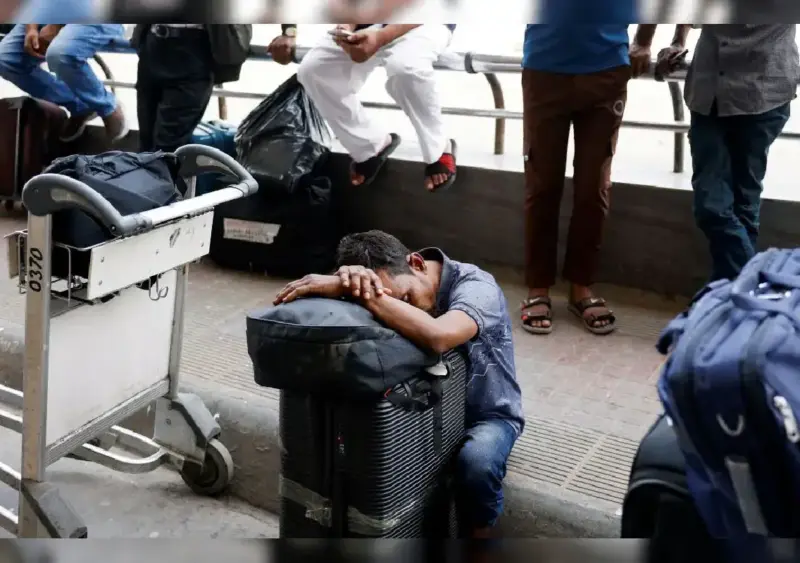

As the conflict involving Iran, United States and Israel disrupts regional airspace, thousands of travellers across the Middle East are experiencing a different kind of stress — the psychological toll of waiting for flights that may never take off .
With frequent cancellations and sudden airspace closures, many travellers say they are constantly refreshing airline apps, checking social media updates and searching for alternative routes just to get home.
Psychologists say this behaviour is a natural response to uncertainty.
According to clinical psychologist Olivia Pounds from The Hummingbird Clinic in Dubai, the human brain is designed to constantly predict what will happen next.
'Our brains are remarkable prediction machines, constantly generating guesses about the future by comparing learnt expectations with new information,' she explained.
However, when situations become unpredictable — such as during wars or major crises — the brain struggles to process the uncertainty.
'In times of stress or danger, these predictive processes heighten as our brains try to anticipate outcomes of threatening situations,' she said.
When clear answers do not appear, anxiety often fills the gap.
Many stranded travellers fall into a familiar pattern: repeatedly checking flight updates, refreshing news feeds and monitoring social media.
While this behaviour feels like taking action, experts say it can actually increase stress.
Dr Pounds noted that constant checking is the brain's attempt to regain control in an unpredictable environment.
But the information found during crises is often incomplete or alarming, which can create an anxiety loop.
'The more the brain searches for certainty, the more it discovers how little certainty exists,' she said.
Psychologist Ezgi Firat says the emotional stress becomes stronger when travellers feel trapped.
'Being unable to leave can feel frightening, while being unable to return home may create frustration or anger,' she explained.
The feeling of being stuck — neither able to move forward nor go back — often produces a strong sense of helplessness.
However, she emphasised that even when uncertainty feels overwhelming, the situation is temporary.
Clinical psychologist Diana Maatouk advises travellers to focus on what remains within their control.
Small steps can make a significant difference, such as:
Limiting exposure to constant news updates can also help reduce stress.
'Continuous monitoring of information keeps the mind in a constant state of alert,' she said.
Travellers often experience emotional swings — relief when a flight appears available and disappointment when it is cancelled.
Behavioural therapist Carolyn Yaffe says acknowledging these feelings rather than suppressing them can help people manage stress.
She recommends focusing on short-term steps rather than distant outcomes, such as planning the next few hours or the next day.
'Breaking worries into smaller, manageable pieces can restore a sense of control,' she said.
While airspace closures and flight cancellations remain outside travellers' control, experts say managing information intake, preparing backup plans and practising self-care can help reduce the emotional strain during uncertain times.