




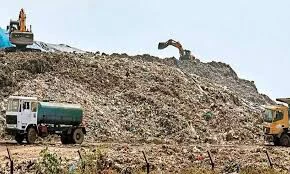

Hyderabad: Secunderabad has finally made it to a global list. Not for innovation, not for infrastructure, but for pollution.
A landfill in Secunderabad has been ranked the fourth-largest methane-emitting waste site in the world in 2025, according to a new satellite-based analysis mapping global pollution hotspots.
The site recorded emissions of 5.9 tonnes of methane per hour, placing it just behind major landfill sites in Argentina, Indonesia, and Malaysia in the global rankings.
The findings come from the latest report (https://law.ucla.edu/news/spotlight-top-25-methane-plumes-2025-landfills) by the University of California, "Spotlight on the Top 25 Methane Plumes in 2025: Landfills," which analysed emissions between January 1 and December 31, 2025, using satellite data.
The landfill has been linked to "potentially responsible operator" Ramky Enviro Engineers.
India features twice in the global top 25, with another major emitter in Maharashtra serving Mumbai, ranked 12th with emissions of 4.9 tonnes per hour and associated with Antony Waste Handling Cell Ltd.
Seen from space: how the world's worst emitters were tracked
The analysis draws on high-resolution methane observations captured by Planet Labs' Tanager-1 satellite and NASA's EMIT instrument aboard the International Space Station. The data was processed by Carbon Mapper and analysed by the UCLA Emmett Institute's Stop Methane Project.
"These insights come from Carbon Mapper's public methane emissions data leveraging two space-based instruments," the report noted.
Researchers identified the largest emitters based on repeated observations across the full year, rather than isolated spikes, ensuring that only persistently high-emitting landfills made the list.
Globally, the dataset captured thousands of methane plumes across hundreds of waste sites, spanning countries across income levels and regions.
What makes Secunderabad's ranking alarming
Methane emissions at this scale are not routine. Most landfills emit relatively small amounts of methane, but the sites on this list operate in a different league altogether.
"While many landfills emit only a few dozen kilograms of methane per hour, those on our 'top 25' list emitted much more," the report said, with emissions reaching several tonnes per hour.
At 5.9 tonnes per hour, the Secunderabad landfill sits among the most intense and persistent methane sources identified globally.
The climate implications are stark.
The report explains: "Over a year, a landfill emitting 5 tonnes of methane per hour… would contribute about as much to global warming as one million SUVs or one large (500 megawatt) coal-fired power plant."
In that context, Secunderabad's emissions are not just locally significant but globally consequential.
Methane: the fast accelerator of climate change
According to the International Energy Agency, methane is responsible for about 30 per cent of global warming since the Industrial Revolution.
Although it remains in the atmosphere for a shorter period than carbon dioxide, around 12 years, its near-term impact is far more potent. Over a 20-year timeframe, methane is estimated to be around 86 times more effective at trapping heat.
Landfills are a major source of organic waste, food scraps, paper, and garden waste, which decomposes without oxygen, producing methane in the process.
Without proper waste segregation, scientific landfill design, or methane capture systems, these sites become continuous emission sources.
How operators were identified
The report goes beyond detection to assign accountability.
Information on "potentially responsible operators" was compiled using publicly available evidence, including mapping data, government records, and facility-level documentation.
In cases where landfill sites were clearly mapped, researchers could directly link them to operators through official records.
The Secunderabad landfill's association with Ramky Enviro Engineers follows this methodology.
However, the report notes that these identifications are based on the best available evidence and are open to further verification.
A warning signal for Indian cities
India's dual presence on the list reflects broader structural issues in urban waste management.
Rapid urbanisation, mixed waste disposal, limited segregation at source, and overburdened landfill infrastructure have turned dump sites into major methane generators.
Delhi's Ghazipur landfill has previously been flagged as a methane "super-emitter," including a 2022 event where emissions briefly crossed 400 tonnes per hour.
The Secunderabad ranking now places Hyderabad's waste system under similar scrutiny, but with a key difference: this is not a one-off spike, but a persistent, high-volume emission source tracked across months.
The way forward
Experts have consistently pointed out that methane mitigation is among the quickest and most cost-effective climate interventions.
The International Energy Agency estimates that over 70 per cent of methane emissions can be reduced using existing technologies, particularly through landfill gas capture, improved waste segregation, and scientific waste processing.
With satellite monitoring making emissions visible and comparable across countries, the space for denial is shrinking.
For Secunderabad, the global spotlight has arrived, albeit for the wrong reason.
What follows next will determine whether this ranking remains a statistic or becomes a turning point.