




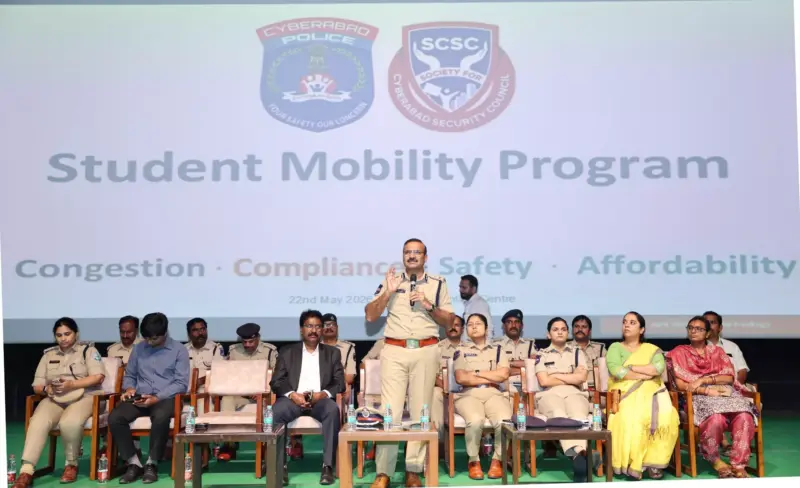

Hyderabad: Nearly two lakh vehicles flood roads outside educational institutions across Cyberabad within just 15 minutes during school dispersal hours, creating traffic congestion.
Cyberabad Commissioner of Police Dr. M. Ramesh said the crisis is at times worse than peak-hour traffic in the city's IT corridor.
The startling revelation emerged from a large-scale survey conducted by Cyberabad Police and the Society for Cyberabad Security Council (SCSC) across 526 educational institutions covering nearly 4.1 lakh students.
Based on the findings, authorities have now launched a technology-driven "Student Mobility Plan" aimed at reducing congestion around schools and colleges, improving student safety, and promoting affordable, organised transport systems.
The initiative was unveiled during an awareness seminar organised jointly by Cyberabad Police and SCSC at the IEI ESCI Centenary Convention Centre in Hyderabad, attended by over 750 representatives from around 500 educational institutions.
Survey exposes transport imbalance
According to the survey findings presented by SCSC CEO Naved Khan, nearly 80% of schools and colleges in Cyberabad already provide transport facilities, but only about 30% of students actually use them.
The remaining students depend largely on private vehicles, leading to a massive influx of cars and two-wheelers around educational campuses during morning and evening hours every day.
Officials said this imbalance has become one of the major contributors to urban traffic congestion in Cyberabad.
Parents' rush leading to unsafe driving
Addressing the gathering, Commissioner Dr M Ramesh said the pressure surrounding school timings was not only worsening traffic conditions but also affecting road safety and family well-being.
He said many parents, in a hurry to drop off or pick up their children, often resort to unsafe driving practices, resulting in frequent accidents, including fatal crashes.
The Commissioner also highlighted the emotional stress faced by children and parents due to poor transport coordination and communication gaps, which sometimes leave students stranded at schools.
He noted that the daily rush during school hours was increasingly affecting children's physical and mental well-being.
Tech platform to coordinate transport
Officials said the Student Mobility Plan would function through an integrated technology platform connecting schools, transport operators, parents, and civic agencies.
The system is expected to improve route planning, streamline pick-up and drop arrangements, enhance safety monitoring, and encourage shared mobility solutions to reduce the number of vehicles on roads.
Authorities said all transport vehicles operating under the system would be required to follow strict safety and regulatory standards.
Gig workers, ASHA staff to aid last-mile connectivity
As part of the initiative, Cyberabad Police also plans to involve gig workers, ASHA workers, and Anganwadi workers in supporting last-mile connectivity for students.
Officials said the move would help strengthen neighbourhood-level safety networks while also creating additional livelihood opportunities.
The Commissioner said the long-term goal was to build a sustainable and transparent urban mobility model that could eventually become a benchmark for other cities.
Civic and transport departments extend support
Narayana Amit, Serilingampally Zonal Commissioner, said student safety should extend beyond school premises and cover the entire journey between home and school.
TGSRTC Deputy Regional Manager Aparna Kalyani said lack of coordination and reliable travel data had long remained a challenge in planning student transport services, adding that the new platform could help address these gaps.
Education department officials also stressed the need to integrate road safety awareness into the schooling system, pointing out that students and young people account for a significant share of road accident victims.
Interactive session with institutions
The seminar concluded with an interactive session where representatives of schools and colleges discussed implementation challenges and sought clarifications on the phased rollout of the mobility plan.
Senior police, civic, and transport officials, including Kukatpally DCP Ritiraj, Women Safety Wing DCP Srijana K, and Traffic DCP Sheshadrini Reddy, participated in the programme and expressed support for the initiative.