




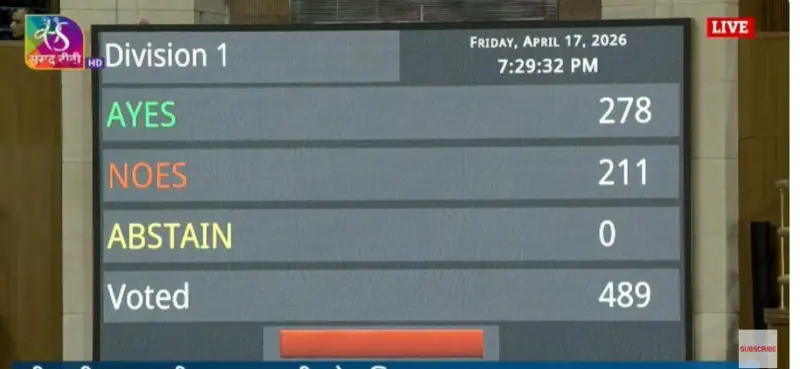

New Delhi/ Hyderabad: History was scripted when the Modi government's Constitution Amendment Bill was defeated in the Parliament.
It is for the first time in over a decade that a government-sponsored bill was defeated on the floor of the House.
Here is an explainer of why this is historic:
Why is this "Historic"?
In a parliamentary democracy, a government usually only brings a Bill to vote when it is certain of its majority. A defeat in the Lower House is rare and often seen as a sign of failed floor management or significant internal dissent.
The 15-Year Gap: This is the first Government Bill to be defeated in the Lok Sabha since the Lokpal Bill in 2011.
The "Elite 6" Club: Since Independence in 1947, thousands of bills have been passed. This is reportedly only the 6th time in nearly 80 years that a Government Bill has been outright defeated in the Lok Sabha.
The 2/3 Threshold: Because it was a Constitution Amendment, it required a "special majority" (2/3 of those present and voting). The government secured 298 votes, but needed 352 to pass the threshold.
The Bill's True Intent: Women or Seats?
The controversy lies in what the 131st Amendment Bill actually aimed to do.
Primary Goal:
BJP government claimed it was to implement 33 percent women's reservation for the 2029 elections.
Opposition explained that it was to carry out delimitation, and due to that, South India was set to lose its hold in the Parliament.
Parliament Seats
The government claimed that seats were to be increased from 543 to 850 to make room for women.
Opposition explained that it was a 'hidden attempt' to increase seats in North India, where the BJP has a hold.
Social Justice
Government claimed that it was for 'Nari Shakti'
Opposition explained that their 'Nari Shakti' would not be possible if there is no proper caste census, as other backward class women also need to be included.
Fact check: "Opposition Blocked Women" Claim
Following the defeat, the BJP has argued that the Opposition is "anti-women." Here is the nuance:
The 2023 Law Already Exists: The Nari Shakti Vandan Adhiniyam (2023), which grants 33% reservation to women, was already passed by both Houses and signed into law.
The 2026 "Condition": The new 131st Amendment sought to make the 2023 reservation conditional on a new Delimitation (redrawing of boundaries) and an increase to 850.
The Conflict: The Opposition (including the Congress and Southern regional parties) argued they were voting against Delimitation, not against women. They contend that the 2023 Law should be implemented immediately without waiting for a seat increase or using outdated 2011 census data.
4. Impact on Southern States
Population vs. Seats: Southern states have been more successful in population control. A delimitation based on old or current population figures would see states like UP and Bihar gain massive seat counts, while Telangana and Tamil Nadu would see their relative political influence shrink.
The Federal Balance: The Opposition argues that by linking women's rights to seat redistribution, the government was attempting to "permanently alter" the federal balance of India.
The defeat was not a rejection of women's reservation (which is already law), but a rejection of linking that reservation to the expansion of Parliament. For the first time in 15 years, the Lok Sabha sent a clear message that a simple majority is not enough to rewrite the constitutional map of India.