




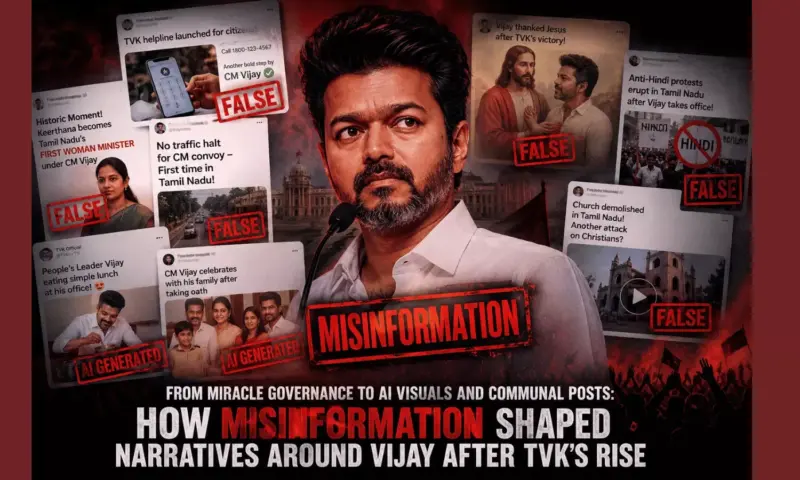

Hyderabad: Barely had Tamilaga Vettri Kazhagam (TVK) come to power in Tamil Nadu before social media appeared to decide that governance had already changed overnight.
Many 'historic firsts' celebrated after Vijay became CM
Across Facebook, X, WhatsApp and YouTube, posts began presenting a picture of a transformed Tamil Nadu under Chief Minister C Joseph Vijay's leadership; new helplines were allegedly launched, administrative practices were said to have changed immediately, and supporters claimed police systems had been overhauled.
Some posts even celebrated 'historic firsts.'
The rush felt reminiscent of the movie 'Mudhalvan', where a television journalist becomes Chief Minister for a day and delivers sweeping changes within hours. The idea of a political hero entering office and instantly transforming governance has long existed in Tamil popular culture.
Rising from films to politics in TN
Tamil Nadu's political history has also seen cinema and politics repeatedly overlap.
Leaders such as MG Ramachandran and J Jayalalithaa entered politics with public images that had already been shaped on screen. Film heroes frequently occupy the role of problem-solvers who cut through bureaucracy and deliver immediate justice. With Vijay making the transition from cinema to politics, some social media narratives appeared to project similar expectations onto him.
How social media is creating competing narratives of Vijay's governance
But a closer look at many of the viral claims reveals something else. Social media was not merely reacting to political change; it was rapidly constructing multiple versions of Vijay at once.
An analysis of recent fact-checks shows that much of the misinformation surrounding Vijay falls into three recurring patterns to serve different purposes:
- Posts crediting Vijay with previous government actions and policies elevated him into an efficient administrator.
- AI-generated visuals attempted to create emotionally resonant moments or political narratives around him.
- Communal narratives focused less on governance and more on Vijay's identity and affiliation.
Here's a detailed look at all three types of misinformation
1. The instant governance narrative
Among the recurring trends identified in recent fact-checks, one pattern stood out prominently. Existing government measures and unrelated developments were repeatedly repackaged as achievements of the new administration.
Special helpline: One viral post claimed Vijay had introduced a special helpline number for citizens to submit complaints and presented it as one of the government's first major administrative decisions. However, fact-checking the claim found that the number was not a newly launched initiative under TVK.
Change in chairs and seating arrangements: Similarly, posts circulated online claiming Vijay had, for the first time, removed the white cloth traditionally placed over the Chief Minister's chair as a sign of simplicity and change in political culture. The narrative portrayed the decision as symbolic and revolutionary.
Fact-checks found no such unprecedented order, and photographs of earlier Chief Ministers, including Karunanidhi, Jayalalithaa and Stalin, showed ordinary chairs being used without such coverings.
In another instance, a government circular regarding seating arrangements for visitors in public offices resurfaced online with claims that Vijay had personally instructed officials to provide chairs and treat citizens more respectfully.
The circular, however, had originated during Stalin's tenure and resurfaced online with a different political framing.
First woman TN minister: Some claims attempted to create entirely new political milestones. One widely shared post portrayed TVK's Keerthana as Tamil Nadu's first woman minister. The claim spread rapidly because it carried the appeal of a historic breakthrough. The reality, however, was very different.
Tamil Nadu's history of women in governance goes back decades.
Even before India's independence, in 1946, Rukmini Lakshmipathi served as the Minister of Public Health in the cabinet led by Tanguturi Prakasam, becoming the first woman minister in the state's political history. After independence, Jyoti Venkatachalam served as Minister for Prohibition and Women's Welfare in the Rajaji-led cabinet in 1953.
Tamil Nadu has also had two women Chief Ministers, Janaki Ramachandran and J Jayalalithaa. Women ministers continued to hold portfolios across successive governments, including leaders such as Geetha Jeevan and Nilofer Kafeel.
The viral post, therefore, attempted to create a historic first where none existed.
Free coaching and CM envoy: A similar pattern appeared in posts that claimed TVK had introduced free coaching programmes for UPSC and TNPSC aspirants for the first time.
However, such programmes had already existed through earlier government initiatives such as Naan Mudhalvan. Another viral claim stated that Vijay had introduced Tamil Nadu's first 'no traffic halt' policy for Chief Ministerial convoys. The system had already been implemented during Stalin's tenure in 2021.
What linked these examples was not simply factual inaccuracy. Existing measures were repeatedly repackaged as fresh reforms, creating the impression that dramatic governance changes had begun almost immediately after the transition of power.
2. Creating moments that never happened
Alongside claims of instant governance came another stream of content showing events that never occurred.
Vijay's photo with family: An image showing Vijay celebrating his assumption of office with his wife and children circulated widely online. The picture portrayed an intimate family moment and was shared as a glimpse into the personal side of the new Chief Minister. Fact-checks later found that the image was AI-generated.
Vijay eating lunch: Another viral image showed Vijay eating a simple home-cooked meal from a lunch box while sitting at his office desk. The image projected humility and simplicity, reinforcing a familiar political image of a leader living an ordinary life despite holding power.
That image, too, turned out to be AI-generated.
Milk abhishekams: A separate visual showed supporters allegedly pouring two lakh litres of milk in celebration of Vijay becoming Chief Minister. Milk abhishekams are a familiar visual language in Tamil cinema and fan culture, often associated with superstar worship. Fact-checks found the viral image had been artificially generated.
Vijay and Rahul: Another image depicted Vijay touching Rahul Gandhi's feet. The image carried political implications because it could influence perceptions regarding hierarchy and political allegiance. It too turned out to be AI-generated.
Individually, these images showed unrelated moments. Together, they appeared to create a carefully assembled personality around Vijay: the family man, the humble leader, the adored political figure and the politician positioned within a larger political landscape.
3. Framing Vijay through religion
Parallel to these narratives was another current of misinformation that repeatedly pushed Vijay's religious identity into focus.
Holy images and portfolio allocations: Several posts attempted to frame him through a communal lens. Old videos resurfaced with claims that Vijay celebrated political success alongside images of Jesus Christ. Fact-checks found that the footage predated the election and was unrelated to TVK's political victory.
Another viral claim suggested that TVK MLA Mustafa had been appointed Minister for Hindu Religious and Charitable Endowments. Given the sensitivity surrounding the portfolio, the claim had the potential to trigger political reactions. Fact-checks found that the claim is false.
Other posts questioned why Vijay allegedly was not wearing sacred ash on his forehead and circulated images claiming he wore a rosary during campaign events.
Unrelated incidents were also drawn into the political conversation.
Demolition of religious places: A video showing the demolition of a church in Kerala was falsely circulated as an incident from Tamil Nadu, creating a communal angle around developments in the state.
Likewise, unrelated videos were circulated claiming anti-Hindi protests had erupted after Vijay assumed office and that people had begun distancing themselves from TVK over the Sanatana Dharma issue.
Unlike posts celebrating governance reforms, these narratives repeatedly shifted attention toward questions of religion and identity.
Interlinking religion and politics
Communal narratives around political developments are not new to India. Similar misinformation has accompanied changes in government across states.
After Congress came to power in Karnataka, Telangana and Kerala, several viral claims attempted to frame governments and political developments through a communal lens, including allegations around minority appeasement and religious favouritism.
In Vijay's case, however, many of the narratives appeared to repeatedly return to his personal background and upbringing by interfaith parents. Rather than focusing only on governance or policy decisions, aspects of his personal identity became points to build political narratives.
Conclusion
Many of the narratives attempted to construct familiar political images around Vijay-the efficient administrator who transformed governance within days, the humble leader eating from a lunch box at his desk, the cultural figure whose religious identity could be repeatedly questioned.
Some narratives elevated him, while others attempted to polarise opinion around him.
Long before governments are assessed through policies and administration, social media appeared to be shaping competing versions of who Vijay is and what his leadership represents.