
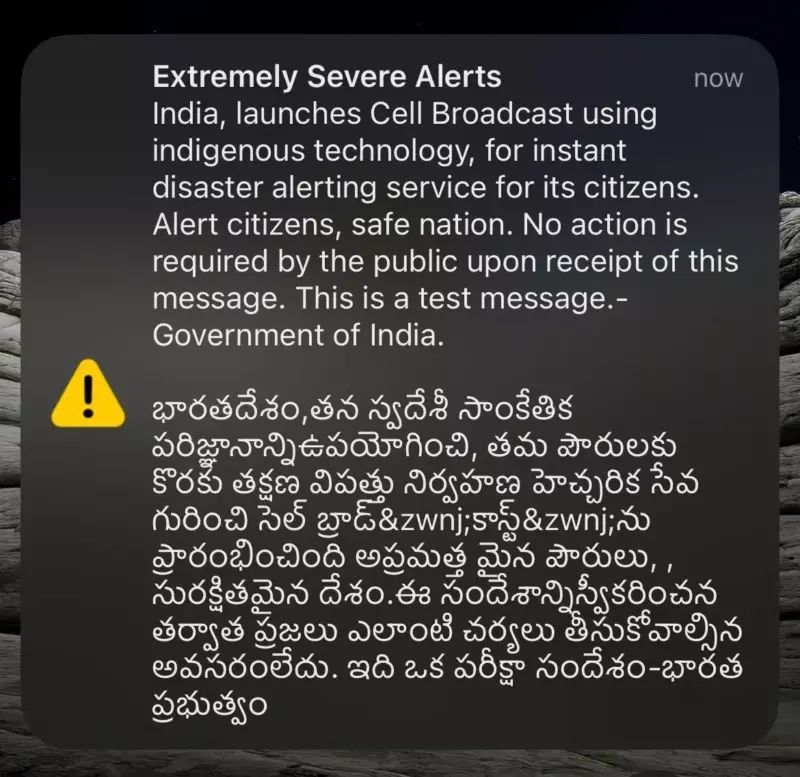

New Delhi: The notification is a test alert transmitted through India's new Cell Broadcast (CB) system, an indigenous mobile-based disaster communication platform developed by the Centre for Development of Telematics (C-DOT), the R&D arm of the Department of Telecommunications.
Union Home Minister Amit Shah and Union Minister of Communications Jyotiraditya Scindia are formally launching the nationwide system today, May 2, 2026. The "Extremely Severe Alerts" tag that appears on the screen is the highest-priority classification in the global Common Alerting Protocol (CAP), the same standard used by international emergency systems and recommended by the International Telecommunication Union (ITU).
In simple terms: the wording sounds dramatic because the system is designed to override silent mode, do-not-disturb settings and even active calls. That loud beep is a feature, not a malfunction.
India is one of the world's most disaster-prone countries. Earthquakes in the Himalayan belt, cyclones along the eastern and western coasts, urban flash floods, lightning strikes, tsunamis, and industrial hazards like gas leaks are all recurring threats. The existing SMS-based SACHET alert system, also built by C-DOT, has already pushed out over 134 billion SMS warnings in 19 Indian languages across all 36 states and Union Territories.
But SMS has a problem: it is slow, can get queued in network congestion, and depends on carrier delivery windows. In a tsunami or earthquake scenario, those delays cost lives.
Cell Broadcast solves this. Instead of sending an individual SMS to each phone number, a CB message is broadcast simultaneously to every compatible mobile device within a defined geographic cell tower zone, within seconds, regardless of network load. Japan uses the same technology to warn citizens before earthquake tremors arrive. The United States uses it for AMBER alerts and the Wireless Emergency Alerts (WEA) system. The UK rolled out a similar service in 2023.
India's version is fully indigenous, built under the Atmanirbhar Bharat push.
Public Reaction: Panic, Memes and Praise
As is now customary in India, the alert hit X before it hit news bulletins. Reactions ranged from genuine concern to typical Indian humour:
● Users in Hyderabad reported receiving the message in Telugu with a few characters appearing as , a Unicode rendering glitch in the regional-language version that has since been flagged by users.
● Several iPhone users said the alert sound was significantly louder than the standard ringer, even on silent mode.
● Some Android users on older devices reported not receiving the alert at all, likely because their Wireless Emergency Alerts setting was disabled.
● Memes comparing the alert tone to "school assembly bell" and "society watchman whistle" began trending within an hour.
Andhra Pradesh State Disaster Management Authority (APSDMA) posted on X urging citizens not to panic, clarifying that repeated test messages are part of the validation process.
How To Enable (Or Disable) These Alerts on Your Phone
Once the system goes fully live, alerts will be mandatory and unblockable for genuine emergencies. But during the current testing phase, only phones with Cell Broadcast test channels enabled will receive them.
On Android: Settings → Safety and emergency → Wireless emergency alerts → Test alerts
On iPhone: Settings → Notifications → Government Alerts → Toggle on/off
If you missed the test alert, it likely means your test channel is disabled, which is fine for now, but worth turning on so you receive future genuine warnings during cyclones, floods or earthquakes.
What Happens Next?
According to officials at the Department of Telecommunications, after this validation phase the Cell Broadcast system will:
1. Be expanded to cover all border districts and poll-bound states once elections conclude.
2. Add tsunami-specific early warning integration with INCOIS Hyderabad.
3. Integrate with IMD's lightning forecast system for state-level precision alerts.
4. Become non-optional on all new mobile handsets sold in India, a mandate already issued by the Ministry of Communications to handset makers.
For Indians, especially in coastal Andhra Pradesh, Odisha, Tamil Nadu, Kerala and Gujarat, the system could be the difference between a warning that arrives in time and one that does not.
Key Takeaways
● The "Extremely Severe Alerts" message is a test, not a real emergency. No action is required.
● It is part of India's new indigenous Cell Broadcast disaster alert system, formally launched today by Amit Shah and Jyotiraditya Scindia.
● The system is built by C-DOT, runs on the SACHETplatform, and uses the global Common Alerting Protocol (CAP).
● Future alerts will cover tsunamis, earthquakes, lightning, gas leaks and chemical hazards.
● Citizens can manage alert settings via Settings → Safety and emergency → Wireless emergency alerts.