
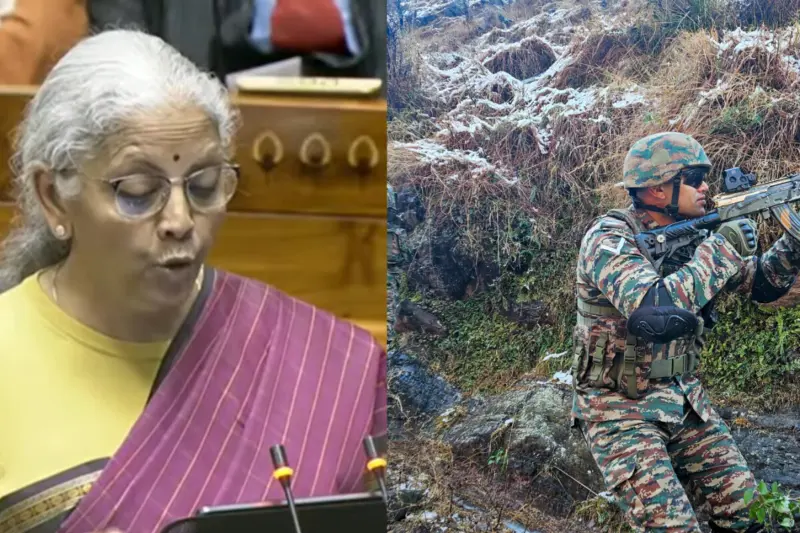

The Ministry of Home Affairs, through its budget, has cleared its priorities focusing on intelligence, border infrastructure, and modernisation, a sweeping Rs 1,73,802.53 crore net budget allocation for police forces in fiscal year 2026-27, marking a 7.1 per cent increase from the previous year's revised estimates of Rs 1,62,283.39 crore and underscoring the government's commitment to national security amid evolving threats.
The budget, presented under Demand No. 51, reveals unprecedented investments across multiple security domains. Capital expenditure has surged dramatically by 84 per cent, from Rs 11,561.10 crore in actual spending during 2024-25 to Rs 21,272.47 crore for 2026-27, signalling a major push toward infrastructure modernisation and technological upgrades.
Border infrastructure receives a massive boost with Rs 5,266.51 crore earmarked for construction projects, while the Intelligence Bureau's allocation has jumped to Rs 6,782.43 crore, driven primarily by a remarkable increase in capital spending from Rs 306.07 crore to Rs 2,549.54 crore. The seven Central Armed Police Forces will receive Rs 1,16,789.30 crore combined, with significant increases across all forces. Women's safety programmes, Left Wing Extremism combat, forensic modernisation, and a new Vibrant Villages Programme highlight the government's multi-pronged approach to internal security. This represents the largest single-year allocation for police and security forces in India's history.
Central Armed Police Forces: The Backbone Strengthened
The seven Central Armed Police Forces (CAPFs), comprising CRPF, BSF, ITBP, CISF, NSG, Assam Rifles, and SSB-will receive a combined Rs 1,16,789.30 crore in 2026-27, up from Rs 1,04,824.10 crore in actual expenditure during 2024-25, representing an 11.4 per cent increase.
The Central Reserve Police Force (CRPF), India's largest paramilitary organisation, leads with Rs 38,517.93 crore, an increase from Rs 34,020.58 crore in 2024-25. The Border Security Force, guarding the Pakistan and Bangladesh borders, receives Rs 29,567.64 crore, maintaining nearly the same level as 2024-25 (Rs 27,938.53 crore).
The Indo-Tibetan Border Police, responsible for the China border, sees a substantial jump to Rs 11,324.08 crore from Rs 9,337.24 crore-a 21.3 per cent increase reflecting heightened focus on northern frontiers.
The Central Industrial Security Force (CISF), after accounting for recoveries, receives Rs 15,973.85 crore net, up from Rs 14,689.74 crore in 2024-25.
Most notably, the National Security Guard, India's elite counter-terrorism force, sees its budget increase to Rs 1,422.47 crore from ₹1,095.91 crore in 2024-25 (actuals), a 30 per cent jump reflecting growing urban terrorism concerns.
Intelligence Capabilities: Unprecedented Expansion
The Intelligence Bureau's allocation has surged to Rs 6,782.43 crore for 2026-27, compared to Rs 4,013.19 crore in actual spending during 2024-25-a 69 per cent increase.
The most striking aspect is the capital expenditure component, which skyrocketed from Rs 306.07 crore in 2024-25 to Rs 2,549.54 crore in 2026-27-more than an eight-fold increase. This suggests major technological upgrades in intelligence-gathering capabilities, surveillance systems, and data analytics infrastructure.
The National Intelligence Grid (NATGRID), designed to link databases for counter-terrorism, receives Rs 108.98 crore, though this represents a decrease from Rs 248.42 crore in 2024-25, possibly indicating that major infrastructure is now in place and the focus has shifted to operations.
Border Infrastructure: Record Investment
Border infrastructure and management receives Rs 5,576.51 crore in 2026-27, broken down as:
Rs 310 crore for maintenance and border check posts, Rs 5,266.51 crore for capital outlay on construction projects. This capital allocation represents a 44 per cent increase from the Rs 3,649.79 crore spent in 2024-25, funding barbed wire fencing, border roads, observation towers, floodlighting, and hi-tech surveillance systems along the Indo-Bangladesh and Indo-Pakistan borders.
The BSF Air Wing, managing aircraft, river boats, and helibases, receives Rs 95.05 crore (Rs 23.04 crore revenue, Rs 72.01 crore capital), up from Rs 72.52 crore in 2024-25.
Police Infrastructure: Building the Foundation
Police infrastructure development receives Rs 5,393.37 crore, a substantial increase from Rs 2,133.18 crore in 2024-25, more than doubling the allocation. The breakdown includes
Rs 5,040.87 crore for building projects of CAPFs and Central Police Organisations (up from rs 1,894.58 crore), Rs 342.50 crore for Delhi Police infrastructure (up from Rs 233.61 crore), Rs 10 crore for assistance to States/UTs for narcotic control.
This massive increase reflects an urgent push to provide modern accommodation, training facilities, and operational infrastructure for the expanding security forces.
Women's Safety: Multi-Pronged Approach
Women's safety schemes receive Rs 889.05 crore in 2026-27, up from Rs 286.42 crore in actual spending during 2024-25, though much of the increase reflects better budgeting rather than net new spending.
Key allocations include: Rs 200 crore transferred to the Nirbhaya Fund, Rs 175.05 crore for Emergency Response Support Systems (up from Rs 30 crore), Rs 500 crore for modernisation of forensic capacities (up from Rs 148.55 crore).
Rs 14 crore for upgradation of Central Forensic Science Laboratories and National Forensic Data Centre, Rs 91.03 crore for Nirbhaya-funded projects for women safety and security.
Safe City projects in various states receive Rs 125 crore, fully met from the Nirbhaya Fund. These projects aim to create safer urban environments through CCTNS integration, surveillance systems, and improved policing.
Forensics Revolution: Building Scientific Investigation
The government is pushing a comprehensive modernisation of forensic infrastructure with significant allocations:
Rs 500 crore for modernisation of forensic capacities. Rs 130 crore for the National Forensic Infrastructure Enhancement Scheme, establishing new CFSL laboratories and NFSU off-campuses nationwide, Rs 14 crore for upgradation of Central Forensic Science Laboratories and the National Forensic Data Centre.
The Inter-Operable Criminal Justice System (ICJS), designed to create integrated digital platforms enabling seamless data sharing among police, courts, prosecution, prisons, and forensic agencies, receives Rs 550 crore-a significant increase from Rs 108.62 crore in 2024-25.
Additionally, Rs 145 crore goes to the National Forensic Science University and Rs 184.40 crore to Rashtriya Raksha University for academic, administrative, research, and infrastructure activities.
Delhi and J&K: Special Security Requirements
Delhi Police receives Rs 12,503.65 crore for 2026-27, comprising Rs 11,881.55 crore in revenue expenditure and Rs 622.10 crore in capital expenditure. This is up from Rs 12,133.16 crore in 2024-25, reflecting the unique security challenges of the national capital.
Jammu & Kashmir Police gets Rs 9,925.50 crore (Rs 9,428.13 crore revenue, Rs 497.37 crore capital), a significant increase from Rs 8,553.38 crore in 2024-25. This 16 per cent increase reflects ongoing security challenges in the union territory and efforts to strengthen local policing capabilities.
Combating Left Wing Extremism
Addressing Maoist insurgency remains a priority with Rs 3,610.80 crore allocated for Security Related Expenditure (SRE) and Special Infrastructure Scheme in the 35 worst-affected Left Wing Extremist districts.
This represents an increase from Rs 2,788.18 crore in 2024-25 and notably includes Rs 430 crore in capital expenditure for 2026-27-the first time capital allocation appears for this programme, suggesting a shift toward permanent infrastructure in affected areas rather than just operational expenses.
Modernisation of Police Forces
The Centre will provide Rs 4,061.34 crore to states through centrally sponsored schemes for police modernisation in 2026-27, up from Rs 2,903.10 crore in 2024-25.
This includes: Rs 450.54 crore for modernisation of state police forces and Crime and Criminal Tracking Network and Systems (CCTNS), Rs 3,610.80 crore for Security Related Expenditure and special infrastructure in LWE areas.
The CCTNS aims to create a comprehensive and integrated system for efficient tracking and investigation of crimes.
Border Villages: Vibrant Villages Programme
A new initiative debuts in 2026-27: the Vibrant Villages Programme Phase-II receives Rs 300.02 crore (Rs 50.02 crore revenue, Rs 250 crore capital) for comprehensive development of selected border villages. This complements the ongoing Phase-I programme, which receives Rs 350 crore as a centrally sponsored scheme. Together, these programmes aim to integrate border populations with the nation by creating better living conditions, road connectivity, infrastructure development, and livelihood opportunities.
The earlier Border Area Development Programme receives only Rs 0.06 lakh in 2026-27, down from Rs 86.41 crore in 2024-25, suggesting most border development has shifted to the Vibrant Villages framework.
Modernisation and Technology Upgrades
Modernisation Plan IV for Central Armed Police Forces receives Rs 343.66 crore (Rs 91.48 crore revenue, Rs 252.18 crore capital) to equip forces with state-of-the-art weapons, equipment, and upgraded IT solutions. Central Police Organisations, including the Narcotics Control Bureau, Bureau of Immigration, National Crime Records Bureau, and National Investigation Agency, receive Rs 2,184.54 crore, up from Rs 1,491.19 crore in 2024-25.
The Special Protection Group, providing security to the Prime Minister, receives Rs 499.99 crore.
Prison Modernisation and Support
Prison modernisation receives Rs 300 crore, up from Rs 43.62 crore in 2024-25, indicating a renewed focus on reforming India's overcrowded prison system.
A new scheme, "Support to Poor Prisoners," debuts with Rs 2 crore to provide financial assistance to indigent prisoners unable to afford penalties or bail amounts.