
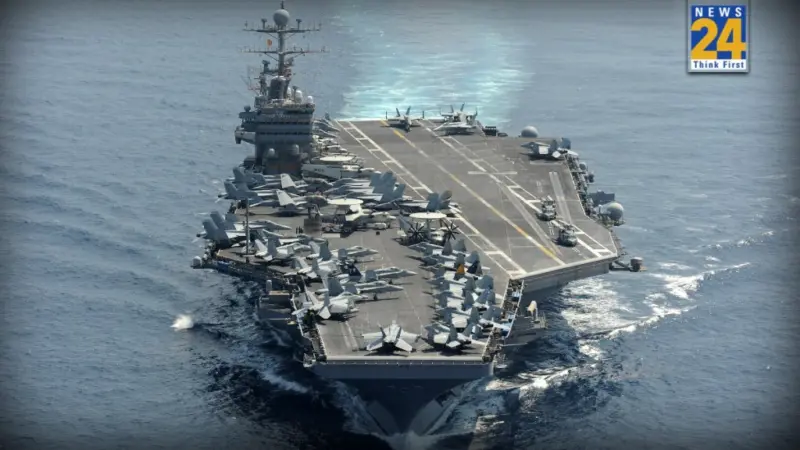

The United States Navy aircraft carrier USS Abraham Lincoln arrived in the Middle East on Monday after being moved from its earlier deployment in the Indo-Pacific region.
The move was made because tensions between the United States and Iran have risen sharply. This has led to speculation that US President Donald Trump may be considering military action, including possible airstrikes on Iran's capital, Tehran.
USS Abraham Lincoln is a large, nuclear-powered aircraft carrier and the main ship of Carrier Strike Group 3. It is one of the most powerful warships in the world and carries fighter jets, helicopters and advanced weapons systems. The carrier passed through the Strait of Malacca on 19 January and was protected during the journey by three guided-missile destroyers: USS Frank E. Petersen Jr., USS Spruance and USS Michael Murphy.
US Central Command, known as CENTCOM, said on social media that the carrier strike group is currently deployed to the Middle East to promote regional security and stability. This deployment has brought thousands of additional US military personnel into the region. It is the first time since October that a US aircraft carrier has been present in Middle Eastern waters. The previous carrier, USS Gerald R. Ford, was later moved to the Caribbean.
Why is the strike group in the Indian Ocean and not the Arabian Sea?
Although the strike group has entered the CENTCOM area of responsibility, it is operating in the Indian Ocean rather than the Arabian Sea, which directly borders Iran. US officials say the carrier has not yet reached its final position. The Indian Ocean provides more open space for large warships and allows the US Navy to operate more safely and flexibly.
From the Indian Ocean, US aircraft and long-range missiles can still reach Iran if needed. At the same time, staying away from the narrower and more sensitive waters of the Arabian Sea and the Persian Gulf reduces the risk of direct clashes with Iranian naval forces. This approach allows the US to remain ready for action without appearing overly aggressive.
What message is the US trying to send to Iran?
President Donald Trump described the deployment as a "big armada" sent "just in case" to monitor Iran's behaviour. By placing the carrier in the Indian Ocean, the US is signalling military strength and readiness while trying to avoid immediate escalation. The move is intended to deter Iran and reassure US allies in the region without provoking a direct naval confrontation.
Despite strong warnings and pressure, Trump has so far not ordered any military strikes against Iran. On 15 January, he said he had received credible information that Iran had stopped killing protesters and that no further executions were planned. Iran strongly denied these claims and criticised the US president, calling him an "international criminal" and accusing him of underestimating Iran and endangering regional stability.
CENTCOM has said the carrier strike group was moved as part of routine operations and maintenance and to support regional security and stability. US officials have avoided confirming any direct link between the deployment and plans for an attack on Iran, stressing that the move is defensive in nature.
Trump has said that all options remain on the table, but for now he appears to be relying on pressure tactics rather than military action. Russia has warned that any US attack on Iran would have disastrous consequences, while China has urged the United States to avoid interference in Iran's internal affairs and to show restraint.
What does the deployment mean for the region?
By keeping USS Abraham Lincoln in the Indian Ocean instead of the Arabian Sea, the United States is trying to balance military preparedness with caution. The positioning allows the US to respond quickly if the situation worsens, while reducing the risk of direct confrontation and helping to prevent the crisis from turning into a wider conflict.