




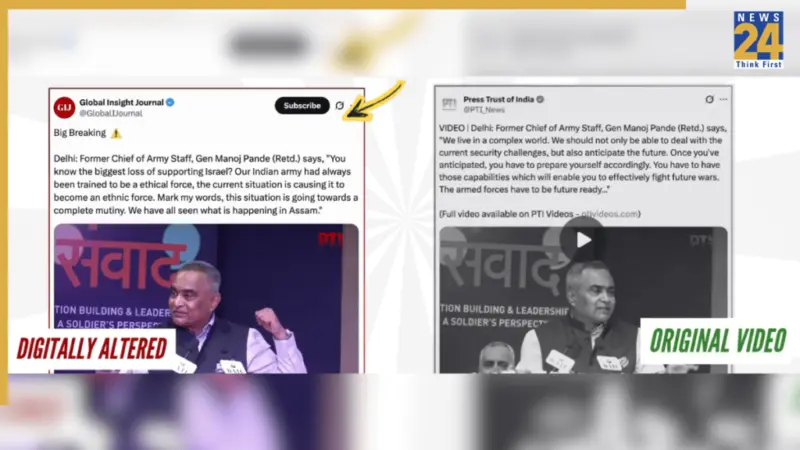

Amid the ongoing tensions involving the United States, Israel and Iran, Pakistani social media accounts have been repeatedly attempting to spread misinformation targeting India.
However, fact-check accounts run by the Press Information Bureau (PIB) and the Ministry of External Affairs have been actively exposing such false propaganda.
In the latest case, PIB Fact Check revealed that Pakistani propaganda accounts are circulating a fake video that falsely shows former Indian Army Chief Manoj Pande making controversial remarks about the Indian Army.
PIB warned people to stay alert and shared both the AI-generated deepfake clip and the original video to clarify the truth. In its statement, PIB said:
"Beware! This is an AI-generated deepfake video. Former Army Chief General Manoj Pande never made such a statement. Pakistani propaganda accounts are circulating manipulated videos as part of a coordinated disinformation campaign to mislead the public and undermine trust in the Indian Army. Always verify information from official and credible sources before sharing."
What Is Shown in the Viral Video?
The manipulated video shows a version of Manoj Pande (Retd.) speaking about the supposed consequences of India supporting Israel. In the fake clip, he is portrayed as saying that the Indian Army was trained to be an ethical force but that Israeli instructors are now training Indian soldiers and allegedly teaching them to view certain communities - including Muslims, Sikhs, Rengma and Kuki - as "not human."
The deepfake video further claims that such training could push the situation towards rebellion within the country and refers to developments in Assam as an example.
The Truth After Fact Check
However, the PIB Fact Check clarified that these statements are completely fabricated and do not appear in the original video.
In reality, Manoj Pande was speaking about preparing the armed forces for future security challenges. In his actual remarks, he said that India must not only understand current security threats but also anticipate future ones. He stressed that once potential challenges are identified, the military must build the capabilities required to deal with future conflicts.
He also noted that armies are often criticised for preparing for the previous war rather than the next one. Therefore, he emphasised the need for acquiring new-generation capabilities so that the armed forces remain ready for future battles.