
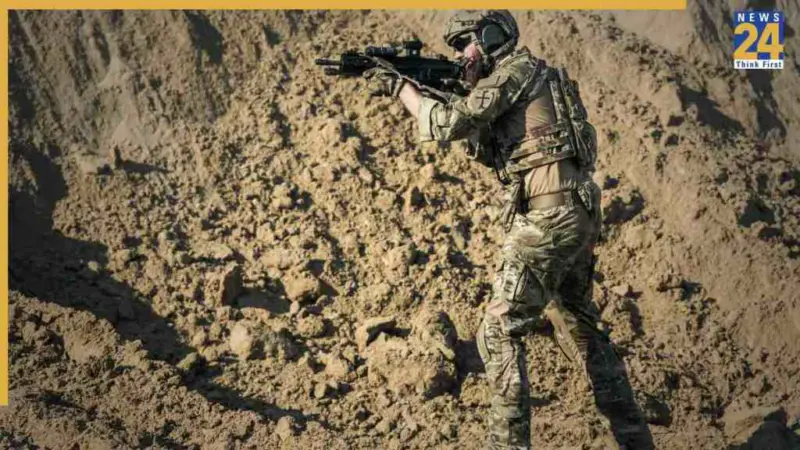

History bears witness that wars are decided not merely by power, strategy, and weaponry, but also by the unpredictable nature of the weather.
Much like Napoleon Bonaparte and Adolf Hitler, harsh winter conditions in Russia played a vital role in defeating both. Now, it is said that the scorching summer heat in Iran could prove fatal for the US military. Amid escalating hostilities between the two countries, the weather serves as a stark warning: the clock is ticking for President Donald Trump to launch a ground invasion in Tehran.
At this pivotal moment, the Strait of Hormuz has emerged as the world's most dangerous "flashpoint." On one side stand Donald Trump's destructive threats, while on the other, Iran's uncompromising stance. However, the ongoing conflict is not confined solely to weapons, drones, and missiles; it includes the uncertainties of the weather, the naval mines laid beneath the seabed, and the intricate maneuvers of diplomacy.
Trump's destructive warning against Iran's hard stance
Following the peace talks in Islamabad on Sunday, tensions between Iran and the US have escalated rather than subsided. Trump has made it abundantly clear that Washington will now be enforcing a complete blockade on all ships entering or exiting the Strait of Hormuz. Meanwhile, Iran has hardened its stance and remains unwilling to halt its nuclear program.
The United States is currently fighting on two distinct fronts. The first challenge lies in the Strait of Hormuz, where the naval mines of Iran have become an obstacle. The second challenge involves ground operations, where the weather is likely to emerge as the greatest challenge. While strategy, weaponry, and power remain crucial, history bears witness that any military force that disregarded the calendar is doomed to ruin.
Will scorching heat in Iran become a graveyard for US troops?
The scorching heat in Iran constitutes an impenetrable natural fortress, one that descends upon the Gulf region starting in late April. It has the potential to turn into a living hell for enemy troops. While forces generally require 10 to 15 days to adjust to the environment of a foreign land, for U.S. soldiers laden with full military gear and uniforms, the weather may become a serious concern.
U.S. Marines clad in uniforms, wearing nearly 50 pounds of gear, regulating their body temperature could become a challenge by late April. In June and July, the temperature inside military vehicles can soar up to 80°C. In such extreme heat, electronic components start malfunctioning, sensors fail to function, and rubber parts begin to melt down. Furthermore, safeguarding fuel and ammunition becomes a key challenge. The guidance systems of missiles and the engines of drones can also overheat, resulting in crashes. Regions such as Ahvaz and Abadan are counted among the world's hottest places as temperatures reach up to 53°C or above during July and August.
Deadliest mistake of Napoleon, Hitler and others
Extreme weather conditions have forced even the mightiest of warriors to their knees. In 1274 and 1281, when Kublai Khan's massive Mongol fleet launched invasions against Japan, violent sea storms destroyed his vessels. The Japanese dubbed this phenomenon Kamikaze, meaning the "Divine Wind."
Napoleon Bonaparte, the former French Emperor, marched with a colossal army to invade Russia. His forces initially succeeded, but the brutal Russian winter soon set in, with temperatures plummeting. French soldiers soon started to perish from the cold, starvation, and disease. Of the 600,000 troops, very few made their way back home. Similarly, Adolf Hitler, the dictator of Germany, also neglected the weather. During World War II, his forces invaded the Soviet Union in 1941, but were not ready for the severe cold. The machinery broke down, and supply lines stretched thin in the freezing weather.
Will history repeat itself?
Now, the big question here is: Will the United States be able to overcome the challenge posed by the heat in Iran, or will 'weather' stand as a formidable barrier against its triumph?