
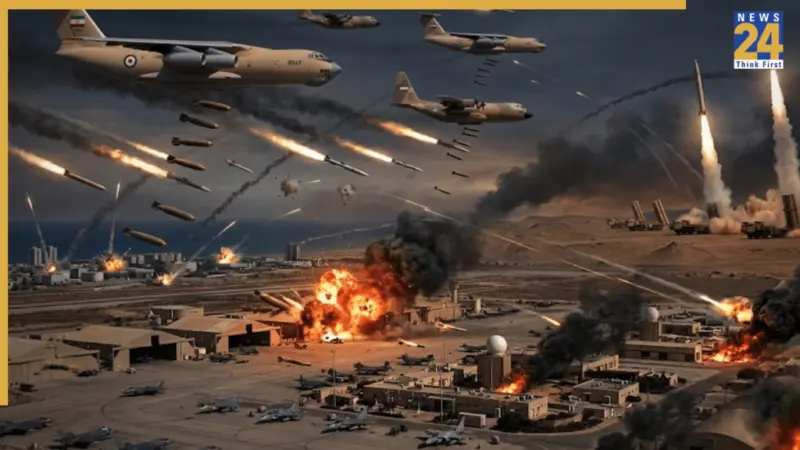

The ongoing war between Israel and Iran has taken a severe turn, with both sides launching heavy missile and ammunition attacks. A new concern has now emerged: according to US officials, Israel has informed United States authorities that its supply of ballistic missile interceptors is running low.
The revelation has raised fresh questions about the conflict. As the US and Israel continue their coordinated actions against Iran, observers are wondering whether Iran is stronger than expected or whether the strategy of the US-Israel alliance is facing unexpected challenges.
US Officials Warn About Declining Interceptor Stock
According to a report by Semafor, a US official said Israel already had a limited number of interceptors when it entered the conflict. Many of these defensive missiles were used during earlier tensions with Iran last year. Now, Iran's continuous missile strikes are putting significant pressure on Israel's long-range air defence systems. Media reports also suggest that Iran has begun adding cluster munitions to some of its missiles, making them harder to intercept.
What Are US Officials Saying?
A US official said Washington had been aware for months that Israel could face a shortage of interceptors. The US expected such a situation and had prepared in advance. However, the official clarified that the US itself does not currently face a shortage of interceptors and that its military capability remains strong. It is still unclear whether the US will supply additional interceptors to Israel. If that happens, it could also put pressure on US stockpiles.
The official added that the US still has enough weapons to protect its military bases and troops stationed in the region. Meanwhile, Israel is exploring other options to deal with the shortage.
How Iranian Missiles Are Challenging Israel
Iran has reportedly started using weapons that can bypass or weaken Israel's Iron Dome defence system. One of these is the cluster bomb. Cluster bombs contain many smaller explosives inside a single missile. When the missile explodes in the air, these smaller bombs spread over a large area and fall to the ground, making them difficult to intercept.
Each small bomb can carry up to around 5 kilograms of explosives. A typical missile may contain about 24 smaller bombs, while Iran's Khorramshahr missile could reportedly carry up to 80 such sub-munitions.
These bombs can spread across an area of 8-10 kilometres. Because they do not always hit a specific target, they can fall on homes, roads, parks, or commercial areas. Although warning sirens are sounded in Israel before ballistic missile attacks, the threat still remains.
How Israel May Respond to Iran's Attacks
Israel has other ways to defend itself from missile strikes. It can use fighter jets to intercept some threats, but interceptors remain the most effective defence against long-range missiles. The Iron Dome system, however, is mainly designed to stop short-range rockets rather than long-range ballistic missiles.
Meanwhile, the US has approved the sale of about 12,000 bombs to Israel. The deal was cleared as an emergency measure without waiting for approval from the US Congress.
Reports also say that during a 12-day conflict with Iran last June, the US used more than 150 THAAD interceptors, which was estimated to be about one-quarter of its total stockpile at the time. In the first five days of the current conflict, the US also used Patriot missile system interceptors worth around $2.4 billion.