
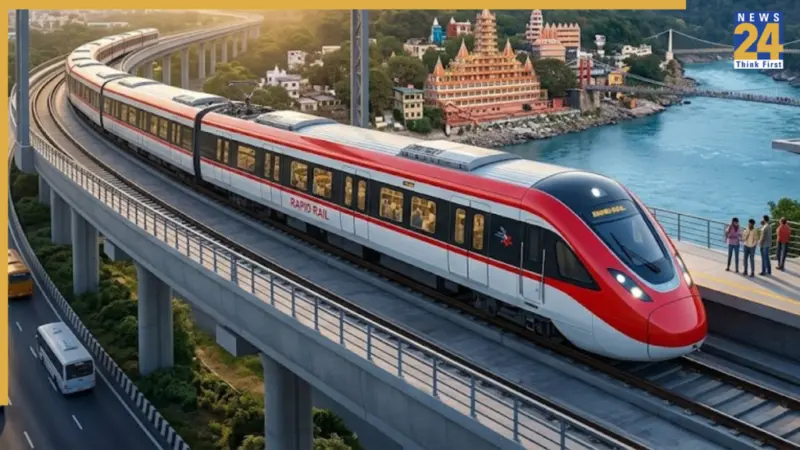

Pushkar Singh Dhami met Manohar Lal Khattar on Saturday to push for extending the Namo Bharat Regional Rapid Transit System corridor from Modipuram in Meerut to Haridwar.
During the meeting, he also proposed a separate metro corridor connecting Dehradun, Haridwar, and Rishikesh. If both proposals are approved, they could create a continuous high-speed rail link from Delhi to the Himalayan foothills, significantly improving regional connectivity.
Current Route and Proposed Expansion
At present, the Namo Bharat train runs between Sarai Kale Khan in Delhi and Modipuram in Meerut. The proposed extension would begin from Modipuram and move northwards towards Haridwar, largely following National Highway 58. This extension is expected to strengthen connectivity between key cities in Uttar Pradesh and Uttarakhand, reduce travel time, and improve accessibility.
Key Stations Along the Route
The planned corridor is expected to pass through several important locations. These include Modipuram in Meerut as the starting point, followed by Daurala-Sakauti, an industrial and education hub. It will then pass through Khatauli near Muzaffarnagar, which serves as a major link point, and Purkazi near the Uttar Pradesh-Uttarakhand border.
Further ahead, the corridor will reach Roorkee, known for its academic importance due to IIT Roorkee. It will then connect Jwalapur in Haridwar, a key tourism and religious area, before ending at Rishikesh, widely known as India's yoga and adventure capital.
What It Would Mean
If the project gets approval, it is expected to bring wide-ranging benefits. Modipuram could emerge as a major junction connecting Delhi and Haridwar routes, leading to increased commercial activity in the region. Muzaffarnagar may see rapid growth in industrial townships and warehousing hubs due to improved connectivity.
Roorkee is likely to witness increased demand for student housing and paying-guest accommodations. At the same time, Haridwar and Rishikesh could see a sharp rise in demand for holiday homes and service apartments, possibly increasing by up to 200 percent.
The travel time between Delhi and Rishikesh could come down to around 2.5 to 3 hours, which would significantly change tourism patterns. Many people from Delhi-NCR may start preferring second homes in Haridwar and Rishikesh instead of nearby cities like Meerut or Muzaffarnagar.
A Larger Economic Vision
Experts believe that this project is not just a transport upgrade but a major economic corridor. It has the potential to reshape development across the Delhi-Meerut-Haridwar belt by boosting real estate, tourism, and business activities. Improved connectivity could attract investments and create new opportunities across multiple sectors.
Challenges Ahead
Despite its benefits, the project faces several major challenges. The stretch between Roorkee and Rishikesh passes through Rajaji National Park and other ecologically sensitive areas. This means strict environmental clearances will be required, which could delay the project.
Land acquisition along National Highway 58 is another concern, as property prices in the area are already high. This could significantly increase the overall cost of the project. Additionally, the hilly terrain near Rishikesh may require elevated tracks or tunnels, adding to both complexity and expenses.
What Happens Next
If there is agreement among all stakeholders, the proposal will be sent to the central government, the Uttar Pradesh government, and NCRTC for detailed evaluation and further action. The next steps will depend on approvals, feasibility studies, and funding decisions.