




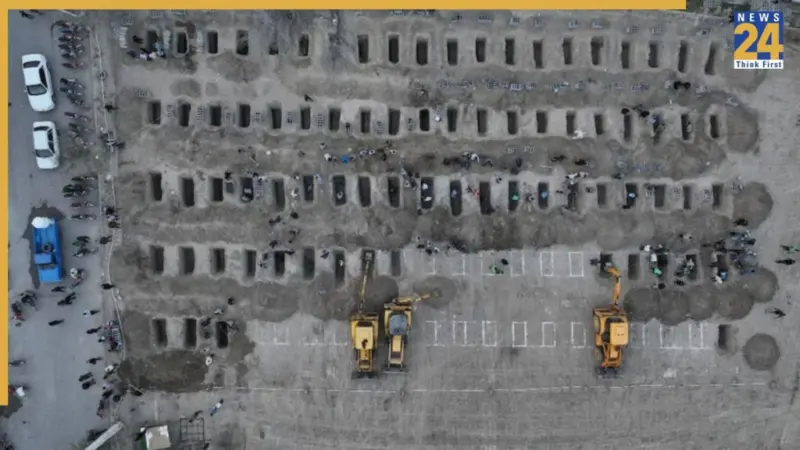

Iran-Israel war: The Artificial Intelligence (AI) system deployed by the US and Israel in their joint attacks on Iran may have identified girls' primary school in southern Iranian city of Minab as a 'legitimate target', killing at least 160 schoolgirls aged between 7 to 12.
According to US officials, the matter is under investigation which has revealed that the school once allegedly housed a base for Iran's Revolutionary Guard Corps (IRGC). The revelation prompted experts to suggest that this piece of information may have accidentally prompted the AI to identify the location as a legitimate target.
Reports also suggest that AI may have targeted a military compound located near the school, but a critical miscalculation caused the US missile to strike the school.
How Iran primary school was targeted?
As per reports, the Shajareh Tayebeh Girls School in Minab city was among the first locations targeted in the joint US-Israeli strikes across Iran on February 28. According to Iranian state media, occurred during class hours, when hundreds of girl students, aged 7 to 12, were present at the school.
The lethal strike completely devastated the school premises, killing more than 180 civilians, majority of them underaged schoolgirls, according to Iranian media reports.
Following the outrage, officials asserted the US never intentionally targets civilian facilities like schools and hospitals, and the matter is being investigated. Later, several US officials acknowledged that the that the attack may have been part of a US military operation, though results of the investigation are pending.
Did AI target the school by mistake?
AI experts observed that while AI targeting is being increasingly used in modern warfare in recent years, it also carries inherent risks, especially if its fed incorrect or outdated information, which is what might have happened in case of the Minab school tragedy.
If an AI system determines that a military base exists at a location, it may choose to target the site based on that outdated information, even though the location now hosts a school, which has been there for at least a couple of years.
Another possibility is an incorrect analysis of the buildings surrounding the target as military installations and civilian buildings are often located in the same area. If the AI algorithm misinterpreted the entire complex as a military zone, it could designate the school as a legitimate target, as it mistakenly believes the structure is part of military infrastructure.
Experts also warn about over-reliance on automated, AI-based targeting, noting that completely removing human scrutiny in the process increases chances of the AI system committing a critical error.
How Minab school tragedy is a grim warning about AI use in warfare?
While the truth of how the Minab school tragedy actually unfolded will hopefully be revealed after proper investigation, the incident serves as a grim warning about how AI systems, despite being highly-advanced, can make critical errors without human scrutiny as the decision-making is based on algorithms, data, and machine learning.
A minor error in the targeting system, or wrong data set, could result in a tragedy similar to the Minab school, raising questions on whether AI should be allowed complete operational freedom in warfare, and if machines should make life-and-death decisions.
However, its pertinent to mention that its unclear whether the missile strike on the Minab school was deliberate human choice or a critical machine error, as civilians are often victims in the fog of war, whether unknowingly or otherwise.
Notably, the US has signed major agreement with AI giants like like Anthropic and Open AI to integrate AI systems in warfare on a large scale.
Israel has also been accused of using the Lavender AI system to to compile a list of thousands of targets during the Gaza war, with multiple reports claiming that the system often chose the wrong targets, raising questions about its accuracy.