
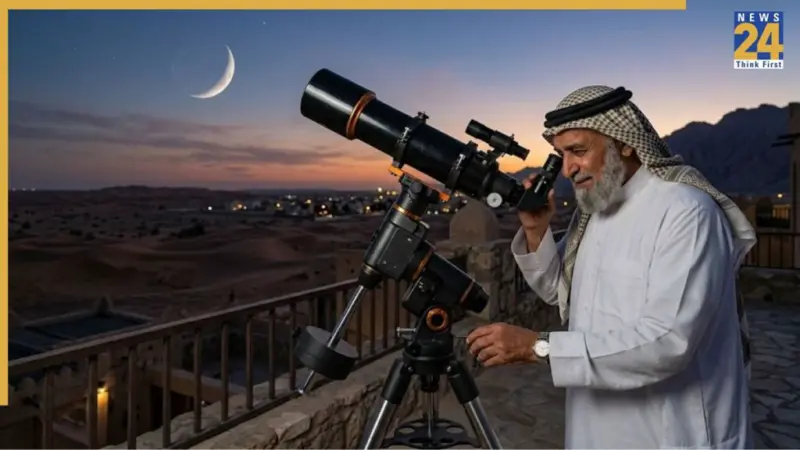

As the holy month of Ramadan 2026 nears its conclusion, Muslims worldwide are looking forward to one of the most eagerly awaited moments in the Islamic calendar: the sighting of the Shawwal crescent, which will determine the start of Eid ul-Fitr.
In Saudi Arabia, authorities have officially called on residents to watch the evening sky on Wednesday, March 18, to spot the new moon.
Supreme Court calls for moon observation
The Supreme Court of Saudi Arabia has urged people across the kingdom to search for the Shawwal crescent on the 29th day of Ramadan, corresponding to March 18, 2026. If the moon is seen that evening, March 19 will be observed as the first day of Eid ul-Fitr, marking the end of a month-long period of fasting, reflection, and devotion.
Officials have also requested that anyone who observes the crescent, whether with the naked eye or binoculars, report it to their nearest court to allow for a verified announcement. This tradition has remained central to the Islamic lunar calendar for centuries.
Eid date determined by crescent visibility
The first day of Shawwal and thus Eid ul-Fitr depends entirely on the crescent moon sighting. If the moon is not visible on March 18, Ramadan will extend to 30 days and Eid will instead fall on March 20, 2026. Experts suggest that the crescent may be difficult to spot in some areas, which could shift celebrations in different countries.
Saudi Arabia's official announcement is closely followed around the world, with several Gulf nations, including the UAE, Qatar and Kuwait, often aligning their Eid celebrations with the kingdom's declaration. In contrast, South Asian countries such as India, Pakistan and Bangladesh usually observe the festival according to local moon sightings.
The significance of moon sighting in Islam
Unlike the solar-based Gregorian calendar, the Islamic calendar is entirely lunar. Each month begins when the new crescent is sighted after sunset. This day, known as Chand Raat, is celebrated with evening festivities, late-night markets and family gatherings as preparations for Eid begin in earnest.
Eid preparations underway
Preparations for Eid ul-Fitr are already visible across Saudi Arabia and beyond. Markets are filled with shoppers buying festive clothing, sweets and gifts, while mosques are preparing for the special Eid prayers that take place early in the morning.
Eid ul-Fitr, meaning 'festival of breaking the fast,' marks the conclusion of Ramadan and is one of Islam's most important celebrations. It is observed with community prayers, family gatherings, feasting and acts of charity such as Zakat al-Fitr, which ensure that even the underprivileged can partake in the festivities.
Awaiting the crescent
As the evening of March 18 approaches, millions of Muslims in Saudi Arabia and worldwide eagerly look to the horizon, hoping to glimpse the slender crescent. Its sighting will officially mark the end of Ramadan and the beginning of Eid ul-Fitr 2026, ushering in a day of joy, prayer and celebration for the global Muslim community.