
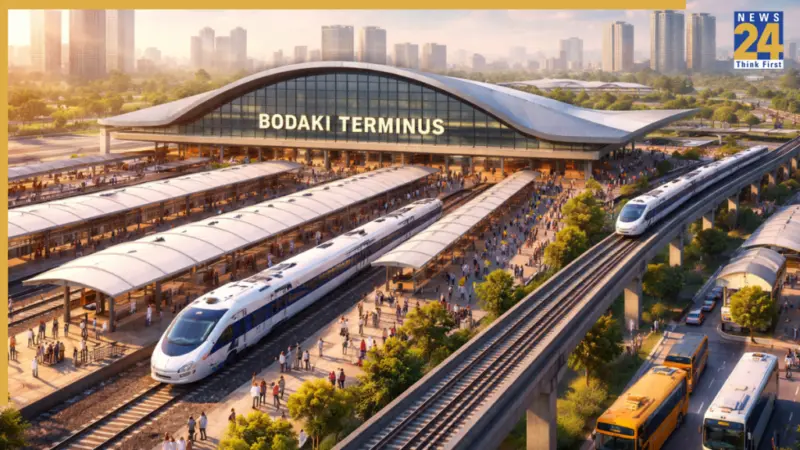

The Bodaki station is being developed as a major alternative to Anand Vihar Terminal. Acting on a proposal from the Railway Ministry, the Greater Noida Authority has begun preparations to acquire additional land for the project.
Earlier, 39 acres were planned for acquisition, but this has now been expanded to 99 acres. The revised plan will support the development of around 13 passenger platforms.
Rising Demand Driven by Noida Airport
With the upcoming Noida International Airport expected to become operational in the coming years, passenger traffic in the region is likely to rise significantly. To manage this surge, the area is being planned as a well-connected transport hub with both bus and metro services.
Once completed, the proposed terminal will reduce the need for passengers from Ghaziabad, Noida, and Greater Noida to travel all the way to Delhi or Anand Vihar. This is expected to ease congestion at both New Delhi and Anand Vihar stations. The project will also ensure direct connectivity with Noida Airport, Jewar, and the Yamuna City region.
Land Requirement and Acquisition Plan
Greater Noida Authority CEO N.G. Ravi Kumar stated that the revised master plan requires around 138 acres of land. To meet this requirement, the authority has started the process of purchasing land across seven nearby villages.
Due to changes in the Bodaki redevelopment plan, an additional 250 acres are also being acquired. This land will be used to provide compensation in the form of land-for-land rehabilitation for affected residents.
The authority will soon finalize revised compensation rates, which will guide the land acquisition process moving forward.
Integrated Multi-Modal Transport Hub
The project is planned as part of an Integrated Industrial Township, developed under the second phase of a multimodal logistics hub. While the tender process for Phase 1 is already underway, construction work is expected to begin soon. This phase involves around 358 acres and an investment of nearly ₹1,700 crore, to be developed with private sector participation.
Villages Under Acquisition and Impact on Farmers
According to officials, land acquisition will take place in seven villages under Section 20A of the Railways Amendment Act, 2008. These include Chamrawali, Bodaki, Dadri, Tilpata Karanwas, Pali, Palla, and Chamrawali Ramgarh.
More than 1,000 farmers are expected to be affected by the acquisition. Authorities have confirmed that they will be given the option of monetary compensation as well as developed plots in return.
ISBT, Metro, and Rail Connectivity in One Hub
Along with the railway terminal, an interstate bus terminal (ISBT) is also planned at the site, similar to ISBT Anand Vihar. Metro connectivity will also be provided through the extension of the Aqua Line from the depot to Bodaki.
Once completed, the hub will offer seamless integration of rail, metro, and bus services in a single complex. The station is planned to have 12-13 platforms and around 63 yard lines, enabling stoppage for over 100 trains, including Vande Bharat and superfast express services.
Railway Chairman's Vision for Future Expansion
Officials revealed that a recent meeting between Uttar Pradesh government representatives, the Greater Noida Authority, and railway officials led to a key recommendation from the Railway Chairman. He noted that Anand Vihar Terminal may soon run out of capacity for additional trains in the future, making it necessary to develop an alternative hub.
He suggested that instead of limiting Bodaki to freight operations, it should also be developed as a passenger terminal. Following this, the Greater Noida terminal plan was formally advanced.
The upcoming hub will not only focus on rail services but will also integrate bus and metro connectivity. In the coming years, it is expected to emerge as a major transit and industrial investment zone. Plans also include expansion of the 105-meter road and rapid development of a multimodal transit hub in Bodaki.
Authorities have confirmed that land acquisition will begin soon, compensation rates will be revised, and eligible farmers will be offered 6% developed plots in return.