




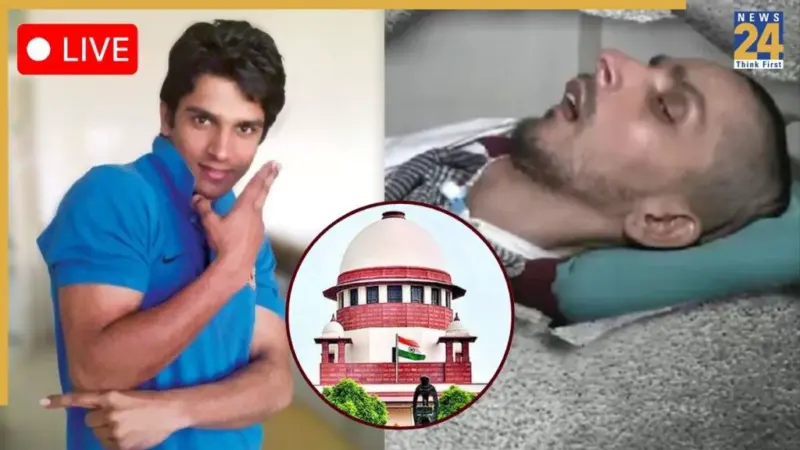

Harish Rana Euthanasia Case Live UPDATES: The Supreme Court of India is expected to deliver its verdict on whether life support can be withdrawn for 31-year-old Harish Rana, who has remained in a vegetative state for over a decade.
The case has sparked intense debate around euthanasia, patients' rights and the legal framework governing end-of-life decisions in India. Follow News24 for the latest updates.
What Happened to Harish Rana?
The incident that changed the Rana family's life occurred on Raksha Bandhan, August 20, 2013. Harish, then a civil engineering student at Chandigarh University, fell from the fourth-floor balcony of his paying guest accommodation.
He suffered severe head injuries that left him with 100% disability. Doctors who treated him initially said he was unable to open his eyes or move his limbs. Since the accident, Harish has remained in a permanent vegetative state.
For the past 13 years, Harish's family has spent most of their time caring for him at All India Institute of Medical Sciences in Delhi. The prolonged treatment has placed heavy financial pressure on the family. His parents, who also have two other children, sold their home in Mahavir Enclave in Delhi and moved to Ghaziabad to manage medical expenses.
Legal Battle for Euthanasia
With little hope of recovery, Harish's parents approached the Delhi High Court in July 2024 seeking permission for euthanasia. Euthanasia, the act of intentionally ending a person's life to relieve suffering caused by an incurable condition, can be categorised as active or passive. Active euthanasia, where death is induced through drugs or injections, remains illegal in India.
However, passive euthanasia, which involves withdrawing or withholding life-sustaining treatment, was first recognised by the Supreme Court in the landmark Aruna Shanbaug case in 2011.
Aruna Shanbaug, a nurse in Mumbai, was sexually assaulted by a ward attendant in 1973, leaving her in a vegetative state for more than four decades. She passed away in 2015 after developing pneumonia.
Later, in the 2018 judgment in Common Cause vs Union of India, the Supreme Court formally legalised passive euthanasia and recognised the right to die with dignity as part of the fundamental right to life.
The upcoming verdict in Harish Rana's case is expected to further clarify how these principles apply to patients who have remained in long-term vegetative states.