
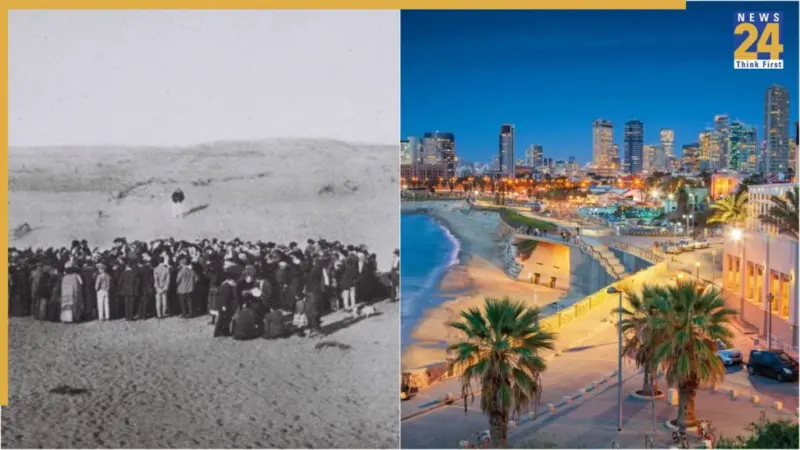

Tel Aviv, which serves as the secondary capital of the State of Israel due to the contested status of its declared capital Jerusalem, is today a bustling metropolis with a population of over 3.3 million.
But did you know that city originated from a small settlement which was once home to just 66 Jewish families?
Let us delve into the history, origins, and foundation of Tel Aviv, Israel's second-largest city.
When was Tel Aviv established?
The origins of Tel Aviv can be traced back to the year 1909 when 66 Jewish families from across Europe, decided to move to their ancestral homeland, and founded a small settlement near the port of Jaffa on the Mediterranean Sea.
The Jewish settlers divided plots of land by tossing seashells to determine where each family's home would be built. Arthur Ruppin, a German Zionist regarded as one of the founders of Tel Aviv, secured a loan from the Jewish National Fund to build what would later be known as the first Hebrew city.
Ruppin, who had moved to Palestine in 1907, named this tiny Jewish suburb, where the Jewish community would live, "Ahuzat Bayit", which means "home" in Hebrew. However, the Zionist leader wanted the desolate settlement to resemble the small European cities and towns Jews had left behind, and thus began work on its development.
Ruppin aimed to develop Ahuzat Bayit as a center of Zionist culture, and wanted the city to be be true to its Hebrew ethos while simultaneously adhering to modern urban standards.
Thus, Ruppin advertised the newly-founded Jewish city as a "city of the future with roads, sidewalks, and electricity. Every home will have running water and sewage piping."
How Ahuzat Bayit became Tel Aviv?
On April 11, 1909, the 66 Jewish families gathered on the beach and picked out shells to determine who would get which piece of land, following which the construction of Ahuzat Bayit began, laying the foundation of Tel Aviv, the future capital of the State of Israel.
In 1910, the settlers decided to rename their new home to something that reflected its ancient, rich history and the Jewish renewal, or re-establishment of Jewish values and heritage.
Thus, Ahuzat Bayit became Tel Aviv, a name derived from the Book of Ezekiel in the Hebrew Bible, where the name is mentioned in the passage referring to the Jews living in Babylon, saying, "Then I came to the captives in Tel Aviv."
Notably, Tel Aviv was also the Hebrew title of the 1902 book, Altneuland (Old New Land) by Theodor Herzl, often called the father of modern political Zionism who formed the Zionist Organization and promoted Jewish immigration to Palestine.
What does 'Tel' and 'Aviv' mean?
The name 'Tel Aviv' is deeply-rooted in Jewish history as "Tel" in Hebrew language refers to an ancient mound beneath which lie layers of archaeological remains of past settlements, while "Aviv" means spring or new life.
Thus, Tel Aviv literally means "new life beginning on the ruins of history", denoting the renewal of Jewish society which began with a tiny settlement of European Jews 117 years ago.
Today, Tel Aviv is the functional capital of Israel and its second-largest city after Jerusalem. The city is home to over 3.3 million people, and is a major economic and technological center, with its metropolitan area 'Gushdan', known for its modern facade and towering skyscrapers.