
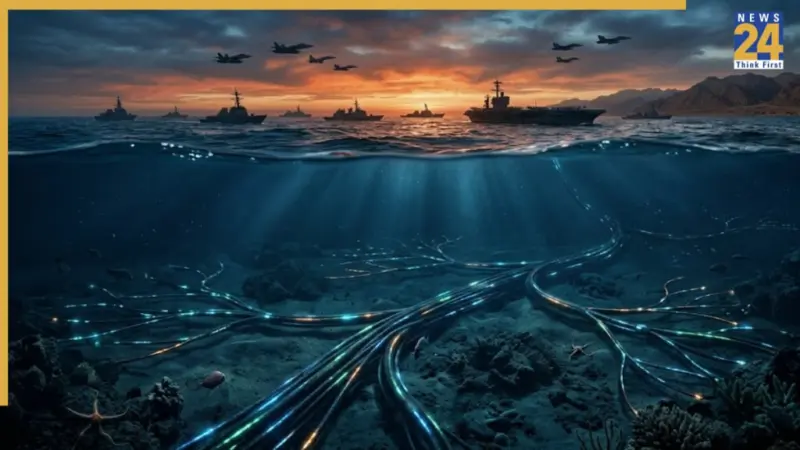

The ongoing US-Israeli war against Iran is raising fresh concerns in West Asia, not only about military escalation but also about the safety of a critical yet largely invisible infrastructure.
It is called undersea fibre-optic internet cables. Experts warn that any disruption to these cables in regions such as the Strait of Hormuz and the Red Sea could affect global internet connectivity and create challenges for countries like India.
Undersea cables form the backbone of the modern internet. According to the International Telecommunication Union, nearly 99 per cent of international internet traffic is carried through submarine fibre-optic cables laid on the ocean floor.
Although Iran has not officially threatened to target such infrastructure during the ongoing conflict, concerns have increased due to the involvement of Iran-backed Houthi rebels in Yemen. The group has previously warned about cutting fibre-optic cables in the Red Sea, raising fears about the safety of this crucial network.
India's Heavy Dependence on Undersea Cable Routes
India's internet connectivity is heavily dependent on these submarine cables. Around 60 per cent of the country's internet traffic passes through routes that travel from Mumbai towards Europe via the Gulf region. The remaining traffic is handled through another route that runs from Chennai toward Singapore and across the Pacific.
This means a large portion of India's digital network relies on cables located in regions currently affected by geopolitical tensions. The Red Sea alone hosts around 17 submarine cables that transmit huge volumes of global data.
Impact of Possible Cable Disruptions
Even if a cable is damaged, experts say the internet is unlikely to completely shut down. The global network works through multiple routes, allowing data to be rerouted if one connection fails. However, such disruptions can still have noticeable effects.