
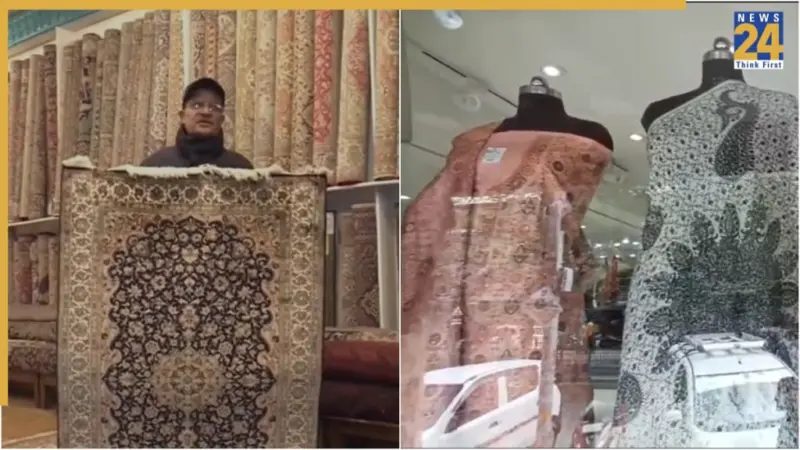

The escalating conflict in West Asia involving Iran, Israel, and the United States is rippling across the globe, hitting Kashmir's famed handicraft industry hard.
Artisans crafting silk carpets and Pashmina products face mounting losses as three major international exhibitions in China, the UAE, and Europe stand cancelled or postponed amid geopolitical tensions.
The Carpet Export Promotion Council (CEPC) under the Ministry of Textiles confirmed the disruptions in an official order. "In view of the prevailing geopolitical tensions and ongoing conflict, the event organisers have informed the Council of the postponement of key international events," it stated. The Copenhagen Lifestyle Expo, set for April 22-26 at FORUM Copenhagen, Denmark, now eyes August. China's Qinghai International Carpet Exhibition, originally planned for June 10-14 in Qinghai, shifts to July. Details on the UAE event remain unclear, but traders report similar halts.
Tariq Ghani, President of the Kashmir Chamber of Commerce, highlighted the fallout. "The ongoing West Asia conflict has significantly impacted Kashmir, particularly the handicraft industry. We had planned three major exhibitions in China, the UAE, and Denmark but all have been postponed. Around 600 orders have already been cancelled. This period is usually our peak export season… Europe remains one of our largest markets."
Kashmir's carpet exports tell a story of decline amid broader challenges. Figures dropped to ₹2,607 million in 2024-25 from ₹3,570 million in 2022-23, per official data. The sector employs nearly 80,000 people and grew dramatically from ₹845.5 million in 1990-91 to a 2015-16 peak of ₹8,215 million. Yet recent shocks, including the Pahalgam attack, compound the crisis.
Tajamul Ahmad, manager at a carpet and shawl showroom, echoed the despair. "The war has had a massive impact… There have been widespread cancellations of exhibitions, and currently, we are relying mostly on local tourists… A large number of orders have been cancelled not only those linked to the Kashmir Government Arts Emporium, but also those handled by private dealers."
Traders urge swift conflict resolution and government intervention via the Chamber of Commerce and Ministry of Textiles to shield exporters and artisans. Without it, the sector's woes could deepen, threatening livelihoods in the Kashmir Valley.