
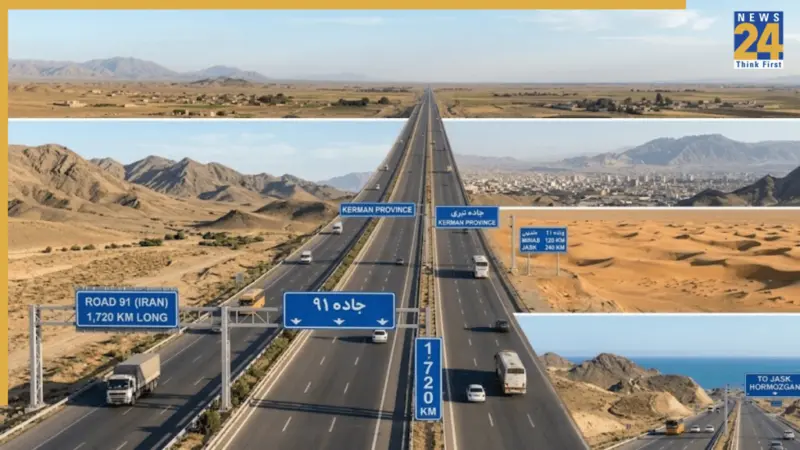

While the world is well aware of Iran's missile and drone capabilities from nearly a month of fighting alone against the US and Israel, the country's strength extends far beyond military power.
Iran also has a well-developed infrastructure, including roads, railways, and air services. Its transport network is extensive, connecting major cities and regions efficiently.
Iran's Longest Highway - Road 91
Iran's longest highway is called Road 91 or Highway 91, stretching about 1,720 kilometers. It begins in Fayzabad in eastern Iran's Razavi Khorasan province and runs all the way to Jask in southern Iran's Hormozgan province. The highway passes through five provinces: Razavi Khorasan, South Khorasan, Yazd, Kerman, and Hormozgan, and connects six major cities.
Why Highway 91 Is Important
Highway 91 links Iran's eastern and southern ends and forms a key part of the Asian Highway 78. This route is vital for trade, serving as the main corridor for the country's economic activity. While some sections are two lanes and others four, it is considered the most important road in Iran. The highway is especially crucial because it connects two key ends of the country, supporting both domestic transport and maritime trade.
Size of Iran's Road Network
Iran's road network is extensive and strategically important given the country's geography, which includes mountains, deserts, and coastlines. The total road network exceeds 220,000 kilometers. If all paved and unpaved roads are included, the total reaches around 737,000 kilometers. The main highways alone cover about 45,000 kilometers. Expressways are also under development, with 2,793 kilometers currently built. The government aims to expand the highway network to 65,000 kilometers.
Iran's Railway Network
Iran also has a significant railway system, totaling around 13,000 kilometers, including 1,500 kilometers of double track. Electrification of the rail network has started, though only 150 kilometers are currently electrified. About 10 kilometers of track are operational for trains, while the rest are under development. The railway network annually handles around 33 million tons of cargo and serves nearly 30 million passengers, highlighting its importance for both trade and travel.