
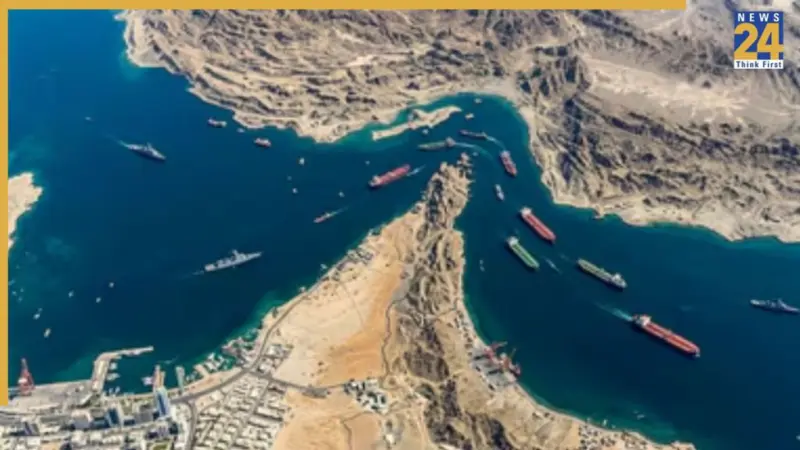

Iran is facing major challenges in fully reopening the Strait of Hormuz, as it is unable to locate and remove all the naval mines it deployed during the recent Middle East conflict, according to US officials cited by The New York Times.
The issue has now become a key obstacle in restoring normal maritime traffic through one of the world's most critical shipping routes.
Mining operation began after conflict escalation
The situation dates back to last month, when Iran started placing naval mines in the strategic waterway using small boats. This move came shortly after the United States and Israel launched military action against the country.
Even at the time, US officials observed that Iran's mine-laying efforts lacked speed and coordination, raising concerns about how effectively the operation was being managed.
Early threats triggered global disruption
Tensions in the region had already begun escalating even before the mines were deployed. On March 2, a senior official from the Islamic Revolutionary Guards Corps warned that the strait was effectively closed and threatened that any vessel entering could be attacked.
The announcement immediately shook global shipping markets, with oil prices witnessing a sharp rise due to fears of supply disruption.
Shipping traffic hit hard
Once the mines were placed, the situation worsened significantly. Tanker movement through the strait dropped sharply, as ships faced the combined threat of mines, as well as possible drone and missile attacks from Iran.
This disruption gave Tehran a strategic advantage during the conflict, allowing it to exert pressure on global trade routes and energy supplies.
Poor planning now limits Iran
However, the same strategy is now creating problems for Iran itself. US officials say the mines were laid in an unstructured and scattered manner and it is unclear whether their exact positions were properly recorded.
In some cases, even recorded mines may have drifted due to water currents, making them harder to locate and remove. This lack of precision has turned the cleanup process into a complex challenge.
Limited passage still open
Despite the risks, Iran has kept a narrow route open for ships willing to pass through under strict conditions. Authorities have warned vessels about the danger of mines, while affiliated media outlets have shared maps showing relatively safer paths, though access remains restricted.
US pressure mounts for reopening
The delay in clearing the strait has slowed Iran's response to international demands, particularly from US President Donald Trump. In a recent social media post, Trump linked the possibility of a two-week ceasefire in the ongoing conflict to the 'complete, immediate and safe' reopening of the strait.
Iran has acknowledged the difficulty. Foreign Minister Abbas Araghchi stated that reopening would happen while taking 'technical limitations' into account, an apparent reference to the mine issue.
Talks in Islamabad to address crisis
The matter is expected to be a central topic in ongoing diplomatic efforts. A 70-member Iranian delegation led by Araghchi is scheduled to meet US Vice President JD Vance in Islamabad for peace talks, where the future of the strait will likely be discussed.
Clearing mines proves a bigger challenge
Experts note that removing naval mines is far more difficult than deploying them. Even the US military relies on specialised vessels, such as littoral combat ships, for mine-clearing operations and does not have unlimited capacity in this area.
Iran, on the other hand, lacks the advanced technology and resources needed to carry out such operations quickly, even for mines it deployed itself.
Ongoing risks remain
Further complicating the situation, US strikes have already damaged Iranian naval infrastructure and destroyed several vessels. However, Iran still has hundreds of small boats capable of laying additional mines or targeting ships.
Tracking these boats during the initial operation proved difficult and US officials still do not have a clear estimate of how many mines were deployed or where exactly they are located.