
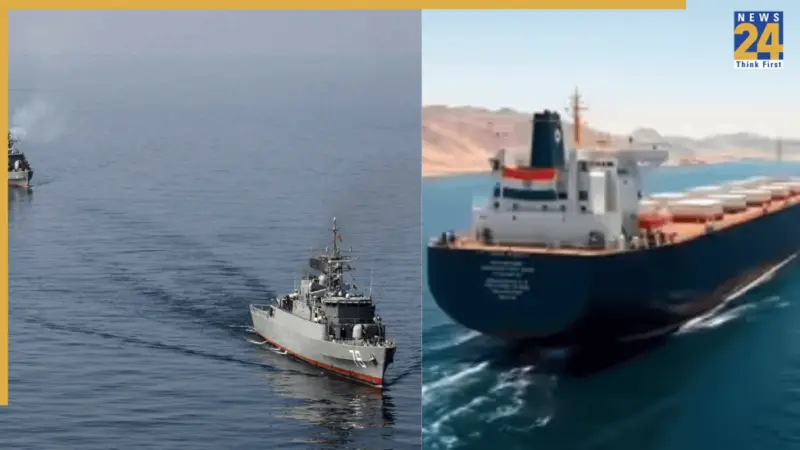

As tensions remain high in the Middle East, the safety of oil tankers passing through the Strait of Hormuz has become a major concern for many countries, including India.
A large share of India's oil and gas imports comes from the Persian Gulf region, and almost all of those shipments must travel through this narrow and strategically sensitive waterway. With fears of missile or drone attacks rising during conflicts, questions are being asked about how long it takes ships to reach Indian ports and what measures are in place to keep them safe.
How Many Days Does It Take from Strait of Hormuz to India?
After leaving the Strait of Hormuz, ships heading toward India's western coast travel across the Arabian Sea to reach major ports such as Kandla in Gujarat or Mumbai in Maharashtra.
The distance from the strait to Kandla Port is roughly 1,000 kilometres, while the journey to Mumbai is longer, usually between 1,450 and 1,560 kilometres depending on the exact route taken.
Oil tankers are extremely large vessels and cannot move at very high speeds. On average, these ships travel at 24 to 31 kilometres per hour. If we take an average speed of around 27 to 28 kilometres per hour, the estimated travel time becomes clearer.
At this speed, a tanker can reach Kandla in about 37 hours, which is roughly one and a half days. The journey to Mumbai takes about 53 hours, slightly more than two days.
However, the actual time can vary depending on weather conditions, sea traffic, cargo load and the route chosen by the ship. In some cases, the total travel time may stretch to two to three days before the vessel reaches its destination in India.
Who Controls Traffic in the Strait of Hormuz?
The Strait of Hormuz lies between Iran and Oman, and at its narrowest point it is only 21 to 33 kilometres wide. Despite its small width, it is one of the most important shipping routes in the world.
Ship movements in this area follow international maritime rules set under the United Nations Convention on the Law of the Sea (UNCLOS). Traffic is also guided by a system designed by the International Maritime Organization (IMO) called the Traffic Separation Scheme, which ensures ships travel in designated lanes.
In practice, however, the region is heavily influenced by the naval presence of several countries. Iran's navy and the Islamic Revolutionary Guard Corps (IRGC) maintain a strong presence in the northern part of the strait, while Oman monitors the southern side. The United States Fifth Fleet is also stationed in the region to help maintain maritime security.
During normal periods, 80 to 130 ships pass through the strait every day. In times of tension, however, shipping traffic can slow down dramatically.
How Indian Ships Could Be Protected
India has been closely monitoring the situation in the Persian Gulf. Reports suggest that 28 to 36 ships flying the Indian flag, including oil and LNG tankers, are currently operating in or around the Gulf region.
To ensure their safety, the government and the Indian Navy are prepared to provide escort protection if needed. In the past, during periods of regional tension, the Navy launched Operation Sankalp, under which warships accompanied merchant vessels through risky waters.
A similar strategy could be used again. Naval ships can travel alongside tankers, providing surveillance and protection as they pass through the Strait of Hormuz and head toward the Arabian Sea.
Authorities have also set up a 24-hour control room to monitor the safety of around 778 Indian sailors currently working on ships in the region.
How Ships Avoid Missile and Drone Threats
Security experts say the main threats in the strait come from missiles, drones, and small fast-moving boats. To reduce risk, ships often follow several safety measures.
One approach is naval escort, where warships accompany tankers and use advanced radar systems and air defence capabilities to detect or intercept incoming threats. Another tactic is routing ships closer to Omani waters, where the risk of confrontation with Iranian forces is considered lower.
Ships also rely on constant monitoring through radar, satellite tracking, and aerial surveillance. These systems help detect suspicious movements early and allow ships to change course if needed.
Due to the ongoing tensions, shipping activity in the region has reportedly fallen sharply, with traffic dropping significantly compared to normal levels.
A Vital Route for India's Energy Security
The Strait of Hormuz remains a crucial lifeline for India's energy needs. Any disruption to shipping in this narrow passage could quickly affect global oil supplies and fuel prices.
For now, Indian authorities say they are working closely with shipping companies and international partners to ensure that energy supplies continue without interruption. Naval escorts and coordinated monitoring remain the most reliable way to ensure that ships carrying vital fuel safely reach Indian ports.