
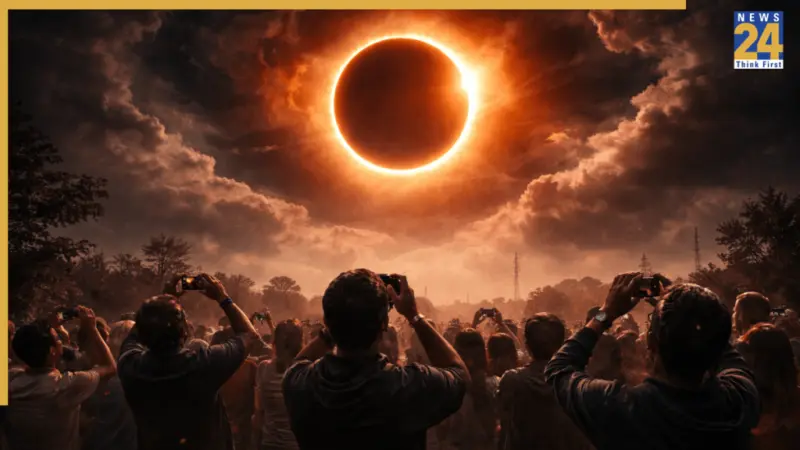

Astronomy enthusiasts around the world are preparing for another remarkable celestial event this year. After the first solar eclipse of 2026 in February, the second one is set to take place in August and is expected to attract global attention.
Solar eclipses occur when the Moon passes between the Earth and the Sun, temporarily blocking sunlight. This rare alignment creates dramatic visual effects in the sky, sometimes turning day into darkness for a few minutes in the regions where the eclipse is fully visible.
Scientists and skywatchers are especially interested in this upcoming eclipse because of its long duration and the wide region it will cover. Such events provide valuable opportunities for researchers to observe the Sun and study changes in the atmosphere during the sudden drop in sunlight.
Surya Grahan 2026: Date and Time
The second solar eclipse of 2026 will occur on August 12, 2026. According to the expected timeline, the eclipse will begin at 9:04 PM and will continue until 4:25 AM on August 13, 2026.
During this event, the Moon will move directly between the Earth and the Sun. In many locations, this alignment will create what is known as an annular solar eclipse, where the Moon does not completely cover the Sun. Instead, a bright ring of sunlight remains visible around the Moon, creating the famous "ring of fire" appearance.
In some parts of the eclipse path, observers may witness a total solar eclipse, where the Moon fully blocks the Sun and the sky briefly turns dark during the daytime.
Where will the eclipse be visible?
The eclipse will be visible mainly across the northern and western regions of the planet. Areas such as the Arctic, Greenland, Iceland, the Atlantic Ocean and northern Spain are expected to experience the most dramatic views.
People in these regions could briefly see daytime turn into twilight as the Moon covers the Sun. Meanwhile, several European countries including France, the United Kingdom and Italy are likely to witness a partial solar eclipse, where only a portion of the Sun is covered.
Solar eclipses often bring unusual natural changes. Temperatures may fall slightly, and birds and animals sometimes behave as if evening has arrived because of the sudden drop in light.
Surya Grahan 2026: Will the eclipse be visible in India?
For people living in India, the eclipse will unfortunately not be visible. The event will occur during the nighttime hours in the country, meaning the Sun will already have set.
Because the eclipse cannot be seen in India, traditional beliefs related to sutak kaal, a religious period that usually begins several hours before an eclipse, will not apply this time. Daily routines, temple activities and other normal work are expected to continue without any restrictions.
Safety tips for watching the eclipse
Even though this eclipse will not be visible from India, those traveling to countries where it can be observed should take proper precautions.
Experts warn that looking directly at the Sun without protection can permanently damage the eyes. Anyone planning to watch the eclipse should only use certified solar viewing glasses or telescopes fitted with special solar filters.
Ordinary sunglasses, camera lenses without filters, or materials like X-ray film are not safe for viewing the Sun and should never be used.
With its long duration and spectacular visual effects, the August 2026 solar eclipse is expected to be one of the most fascinating astronomical events of the year.