





The United Arab Emirates (UAE) has announced its withdrawal from the Organisation of the Petroleum Exporting Countries (OPEC) and OPEC+, in a blow to oil-exporting groups and their de facto leader, Saudi Arabia.
This marks a major shift in global energy politics amid the ongoing international oil supply crisis.
In a statement shared on X, UAE Energy Minister Suhail Al Mazrouei said the move is in line with the country's long-term energy strategy.
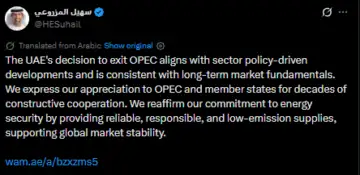
"The UAE's decision to exit OPEC aligns with sector policy-driven developments and is consistent with long-term market fundamentals," he said.
He also thanked OPEC and its member nations for years of cooperation.
"We express our appreciation to OPEC and member states for decades of constructive cooperation. We reaffirm our commitment to energy security by providing reliable, responsible, and low-emission supplies, supporting global market stability," the minister added.
Middle East conflict adds pressure on global oil supply
The UAE's exit comes at a time when the Middle East conflict has already disrupted global oil supply and increased uncertainty in international markets.
A major concern remains the security of the Strait of Hormuz, one of the world's most critical oil shipping routes.
Nearly one-fifth of the world's oil and liquefied natural gas passes through this narrow waterway. Any disruption in this route directly impacts global energy prices and supply chains.
Big win for Donald Trump?
This has also been framed as a political victory by Donald Trump, who has repeatedly criticised OPEC for its role in influencing oil prices. Trump has accused the group of "ripping off the rest of the world" by keeping prices elevated. He has also had linked US commitments in the Gulf to oil pricing, arguing that while Washington provides military protection to member states, they "exploit this by imposing high oil prices".