
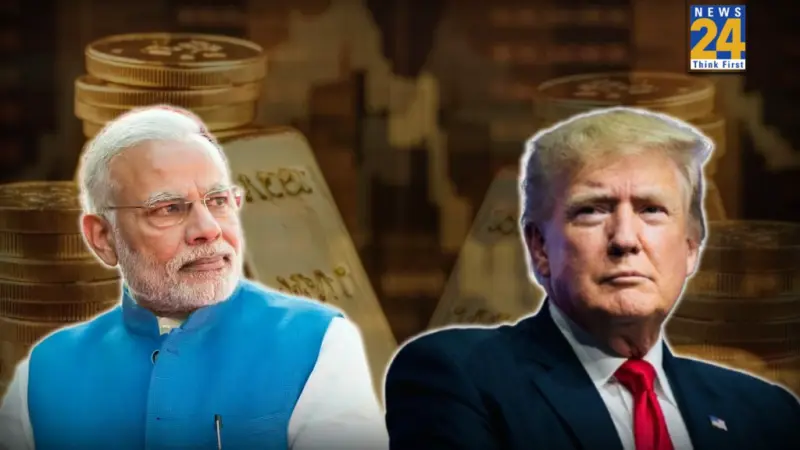

The United States is one of the most powerful countries in the world. A country is considered powerful when its economic situation is strong, and gold reserves play a crucial role in this.
The US has the largest gold reserves in the world. This stock was not built up in just 10 or 20 years. Now the question is, how did the US accumulate such a large gold reserve? How much gold does India have? What are the benefits for a country that possesses significant gold reserves?
The United States, under the leadership of President Donald Trump, has repeatedly made headlines. After abducting Venezuelan president from his home, and later imprisoning in the US, Trump is now trying to claim Greenland by force. Trump has issued direct threats to NATO countries and fuelled ongoing protests in Iran by threatening the Iranian Supreme leader Khamenei. Many countries have expressed concern and alarm over these actions. It appears that the US, feels free to act and speak anywhere, at any time, without restraint and even unwilling to abide by international rules.
Interestingly, this only happens when a country is truly powerful, has a strong economy, a powerful military, and a stable currency. And the US possesses all of these attributes today. Its vast gold reserves, exceeding eight thousand tons, give it immense strength on the world stage.
In this article, we have explored what it means for a country to have a large amount of gold. How does it benefit a country? How did the United States acquire such a large gold reserve? How much gold does India have?
How did the US accumulate such a large amount of gold?
The US is the world's largest economy, currently holding over 8,100 tons of gold, stored in Fort Knox, the New York Fed's vault, and other reserve locations. This gold didn't appear overnight; it accumulated in different phases over approximately 100 years.
1. Gold Rushes and Early Mining
In the 19th century, the US experienced several gold rushes, such as the California Gold Rush (1848). Large quantities of gold were extracted from domestic mines and gradually made their way into government reserves.
2. World War I and World War II
During both World Wars, Europe and other countries sent gold to the US for security and payment. Countries needed weapons, food, oil, and other necessities during wartime. Many countries paid in dollars or gold. The US was comparatively safe, so many countries also shifted their gold reserves to American vaults.
3. The Bretton Woods System Provided Strength
In 1944, after the Bretton Woods Agreement, the dollar became the world's reference currency and was linked to gold. At that time, 1 ounce of gold was fixed at USD 35. Other countries pegged their currencies to the dollar, and the dollar was pegged to gold. Countries with larger export surpluses accumulated more dollars and could exchange those dollars for gold from the US, but the real power remained with the US. In this system, a large part of the world became dependent on the US for its gold reserves, trade surpluses, and security, giving the US power in both gold and dollars.
India's position in terms of gold
In terms of reserves: According to the World Gold Council, India has approximately 880 tons of gold, making it the world's 8th largest official gold reserve holder. Gold is estimated to account for about 78% of India's total foreign reserves (dollars, euros, bonds, gold). These figures may fluctuate slightly over time.
The cultural capital of gold: In India, gold is not just an investment, it is an emotion and a tradition. Buying gold is considered auspicious on occasions like weddings, festivals, Dhanteras, Akshaya Tritiya. The gold kept in temples and household lockers is not reflected in official statistics. However, India still plays a very significant role in the global gold market. According to estimates, Indian households and temples may hold 20,000-25,000 tons of gold, which is considered the largest private gold holding in the world.
The significance of gold for the economy: When people buy gold, it counts as a form of domestic savings. Jewellery, minted gold coins, gold ETFs, Sovereign Gold Bonds - all these incorporate gold into the financial system in a structured way.
The government has attempted to reduce the demand for physical gold and control the current account deficit by introducing schemes like Sovereign Gold Bonds. These schemes allow people to invest in gold without increasing the import bill, while still giving them the benefits of gold investment.
| Country/Entity | Gold Reserves (in tons) |
|---|---|
| United States (USA) | 8,133 |
| Germany | 3,350 |
| IMF | 2,814 |
| Italy | 2,451 |
| France | 2,437 |
| Russia | 2,326 |
| China | 2,305 |
| Switzerland | 1,039 |
| India | 880 |
| Japan | 846 |