
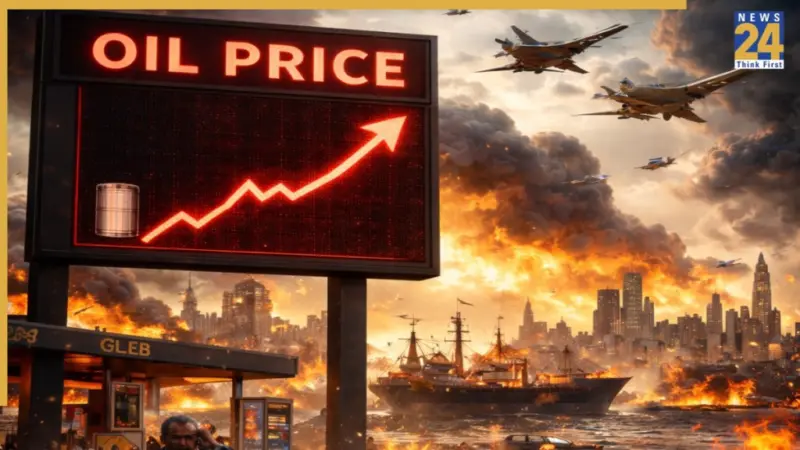

Global oil prices crossed USD 100 per barrel on Monday for the first time since July 2022, as growing tensions in the Middle East raised concerns about global oil supply.
The price of Brent Crude rose to USD 102.50 per barrel, while West Texas Intermediate (WTI) Crude reached USD 101.20. Both benchmarks have increased by around 8% compared with last week.
Why are crude oil prices rising?
Oil prices are increasing mainly because of rising tensions in the Middle East and disruptions to key shipping routes. The conflict involving Iran has now entered its second week, raising fears that global oil supply could be affected further. The crisis has made investors cautious, pushing them to move money into safer assets while energy markets remain unstable.
What role does the Strait of Hormuz play in global oil supply?
A major factor behind the price rise is disruption in the Strait of Hormuz, one of the most important oil shipping routes in the world. Nearly 20% of the world's oil supply passes through this narrow waterway, which connects the Persian Gulf to the open sea. Reports suggest that shipping through the strait has nearly stopped, slowing oil exports from one of the world's largest oil-producing regions. Because of these disruptions, shipping costs have increased by about 30%, adding more pressure to oil prices.
How are OPEC+ production cuts affecting prices?
Another important reason for higher oil prices is the ongoing production policy of OPEC+. The group of major oil-producing countries has decided to continue its production cut of 2.2 million barrels per day. With less oil being produced and supply risks rising, global prices have continued to move higher.
How are financial markets reacting to the crisis?
According to a report by Bloomberg, rising geopolitical tensions have made investors reduce exposure to riskier assets. Many investors are shifting their money into safer investments, and the US dollar has strengthened against other major currencies as it is often seen as a safe-haven during global conflicts.
The conflict in the region has continued to intensify. On Sunday, Iran launched attacks across parts of the Middle East, while Israel targeted fuel depots in Tehran. Israel also warned that it could strike Iran's power grid as tensions rise further. Donald Trump said the United States could consider attacking areas that had not been targeted before. In a social media post, he said strikes would continue "until they surrender or completely collapse".
How are oil-producing countries responding?
As the situation worsens, some oil-producing nations are adjusting their output. Both United Arab Emirates and Kuwait have begun scaling back oil production due to the disruption caused by the near-closure of the Strait of Hormuz. The slowdown in exports from the region has added further uncertainty to global energy markets and is likely to keep oil prices under pressure in the coming days.