




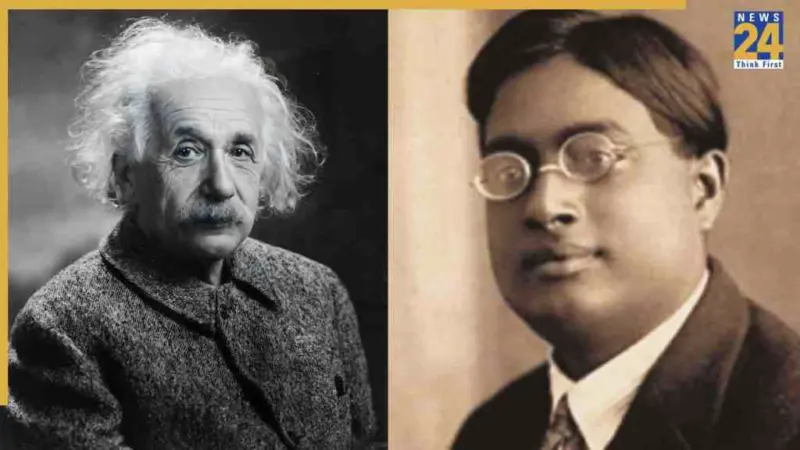

On a summer day in 1924, Albert Einstein opened a letter from a 30-year-old Indian physicist whom he had never met. At that time, Satyendra Nath Bose, a lecturer at the University of Dhaka, had sent him the 5-page paper in which he introduced himself as "a complete stranger." According to reports, the paper claimed to solve a problem of quantum theory that Einstein himself couldn't resolve.
In the paper, Bose explained that he had found a new derivation of Planck's law of radiation and asked for Albert Einstein's help in publishing it. To Bose's astonishment, Einstein replied. He, in fact, translated the manuscript into the German language and arranged for its publication in Zeitschrift für Physik, a leading European physics journal during that time. Additionally, Einstein added a footnote supporting Bose's work. Who thought that this exchange between a colonial Indian physicist and the world's most famous scientist would reshape the quantum mechanics foundation.
Who was Satyendra Nath Bose?
Born on January 1, 1894, in Calcutta (present-day Kolkata), Satyendra Nath Bose was the eldest among seven children. His father worked for the East Indian Railway Company.
Bose was academically a very bright student. In 1915, he secured first place in his examinations at Presidency College and earned his MSc in mixed mathematics. He was a polyglot, fluent in English, Bengali, French, Sanskrit, and German. He, along with his colleague Meghnad Saha, produced the first English translation of Albert Einstein's papers on relativity in 1919 and arranged for its publication by the University of Calcutta.
About Bose's 1924 paper
In his June 1924 paper, what Bose did was seemingly simple but conceptually radical. He proposed that identical quantum particles, like photons, are exactly alike and have no individual identity. The concept that photons can occupy the same quantum state simultaneously required a completely new way of counting particles. The statistics that resulted from it replaced the classical methods of Maxwell and Boltzmann with something that operated at the quantum scale.
Einstein extends Bose's new derivation
Einstein applied Bose's strategic approach from photons to atoms and predicted that at extremely low temperatures, particles would collapse into the same quantum state. In 1995, the phenomenon, known as the Bose-Einstein condensate, was confirmed experimentally by Wolfgang Ketterle, Eric Cornell, and Carl Wieman, who shared the 2001 Nobel Prize in Physics.
Bose ranked 1 among the world's greatest physicists
Physicist Paul Dirac named the particles that obey this new statistics as bosons, in honour of Bose. Using the same convention, the discovery of Higgs bosons in 2012 won Francois Englert and Peter Higgs the 2013 Nobel Prize. While Bose himself received one, seven Nobel Prizes have been awarded for research related to his foundational concepts. Soviet physicist Lev Landau, who ranked himself 2.5 among the world's greatest physicists, ranked Bose at number 1, alongside Erwin Schrödinger, Werner Heisenberg, Niels Bohr, and Paul Dirac.
Awarded Padma Vibhushan in 1954
After the publication of his paper, Satyendra Nath Bose spent two years in Europe, working in Paris and Berlin. In 1926, he returned to Dhaka and spent 20 years teaching and building physics departments before shifting to Calcutta in 1945. He was awarded the Padma Vibhushan in 1954 and later appointed National Professor in 1959. In 1937, Rabindranath Tagore dedicated Visva-Parichay, his only book on science, to Bose. He passed away on February 4, 1974, in Kolkata at the age of 80.