
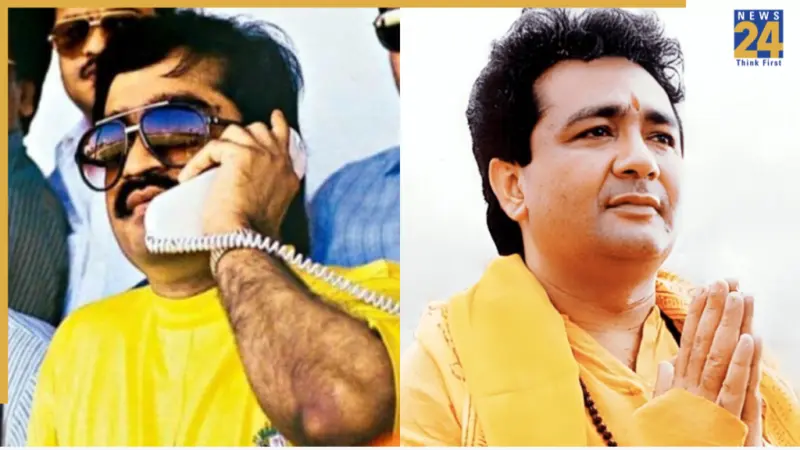

Filmmaker Ram Gopal Varma recently recalled one of Hindi cinema's most turbulent times: the 1990s, when the Hindi film industry was under power of Mumbai gangsters.
He exposed threats, funding across borders, and pressure on whom to cast in films were often driven by underworld groups led by Dawood Ibrahim, and explained why big names like Rakesh Roshan, Gulshan Kumar were threatened and attacked.
How did the underworld target Bollywood in the 90s?
In a conversation with crime author Hussain Zaidi on his YouTube channel, Varma stated that underworld's actions were not random but typically aimed at high-profile targets. According to him, crime syndicates used fear and threats as a weapon to dominate certain influential figures. "When the underworld wants to show its power, it targets big names like Rakesh Roshan, Salman Khan and Shah Rukh Khan," he explained, stating these underworld figures often saw themselves as heroic, larger-than-life personalities.
What did the underworld really want to achieve?
He emphasized that the aim wasn't just money; it was beyond control and power. By dominating big stars, their motive was to assert power and authority. Varma said, "To become a 'hero', they need to overpower someone bigger. These are big stars, you can't just get Hrithik Roshan's dates. So they create fear. The idea is: if the star refuses, what will happen to him?."
Who was the real culprit?
He also noticed the chaos over who the real culprit was behind these threats, whether it was Chhota Shakeel, Dawood Ibrahim's network, or others. RGV said, "Many people were not giving in to gangsters' demands, so they had to set an example-'Look what happened to him, it can happen to you too.' There's a saying in the underworld: 'Kill one, extort money from ten."
Why was Rakesh Roshan threatened after Kaho Naa… Pyaar Hai?
Varma also connected this atmosphere of threat to the filming of Rakesh Roshan in January 2000, soon after Kaho Naa… Pyaar Hai became successful.
"They wanted Hrithik Roshan's dates. The plan was to make a film together, there would be a front name, but Chhota Shakeel would control things from behind. Rakesh Roshan resisted that, and that's why shots were fired," Varma claimed.
What did Rakesh Roshan say on underworld pressure?
On January 21, 2000, Rakesh Roshan was shot outside his office, in an attack which was widely linked to underworld. He survived the incident. Reflecting on gangsters' pressures for Hrithik's shoot dates, Rakesh told in a 2025 interview with Bollywood Hungama, "I never gave any indication that Hrithik could do a film for them. I kept putting them off saying Hrithik had no dates, which in any case, was the truth. They then asked me to take dates away from other producers and give it to them. This again, I refused to do." He had described that time as 'full of fear"
What was the reason behind Gulshan Kumar's murder?
Speaking about Gulshan Kumar's assassination in August 1997, Varma highlighted various key factors. "At one point, Gulshan Kumar was extremely successful-people were jealous. He was introducing new talent and making money," he said, revisiting an atmosphere where even unrelated failures were attributed to him. "If anything went wrong, the first reaction was-'Gulshan Kumar must have done something.' That was the mindset."
RGV further added, "Some people would meet Abu Salem and, out of jealousy, say things about Gulshan Kumar. Influenced by that, he might have thought that killing him would make him a 'hero'. I'm not justifying it, but that was one reason."
What was Abu Salem's motive?
Reflecting to extortion demands and Kumar's refusal to fulfill it, Varma said, "He was not someone who would get scared. A man of his stature wouldn't be intimidated by a phone call." Another reason, Varma said, was Abu Salem's motive to destroy D-Company and assert his own power and identity. "He saw this as his 'film', his big move. After Gulshan Kumar was killed, Abu Salem became more famous than even Dawood Ibrahim for a while."
The day when Gulshan Kumar was murdered
Recalling the day of the murder, Varma said, "I was at Jhamu Sugandh's house when he got the call. He was shaken and immediately left for Gulshan Kumar's home." Varma, who later explored these underworld, mafia themes in his films like Satya, Company and D, said many of these stories were extracted from real-life incidents.