

India's parliament debated, procedurally maneuvered, and ultimately failed to pass a constitution amendment bill on women's parliamentary reservation last week.
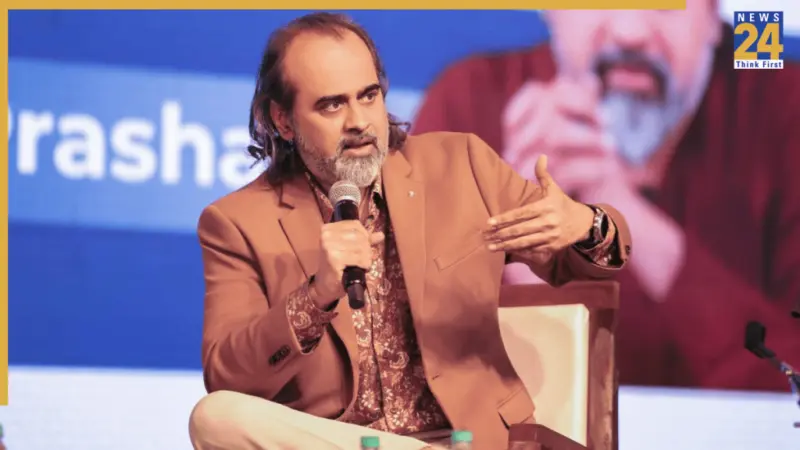
For philosopher and author Acharya Prashant, the defeat is beside the point. So, for that matter, would have been the victory.
"The seat is not the same as the freedom," Acharya Prashant wrote in a commentary on the bill, which fell short of the two-thirds majority it required in the Lok Sabha. His argument is not against reservation in principle. It is a challenge to the premise that the seats, if awarded, would go to the women the bill's proponents imagine.
The numbers complicate the optimism. Women currently hold between twelve and fifteen per cent of Lok Sabha seats. Of those, roughly half have arrived through dynastic passage: wives, daughters, or daughters-in-law of established political figures. Among male MPs, the equivalent figure is around twenty-five per cent. Tripling the share of women's seats does not change the pool from which candidates are drawn; it expands the demand on a pool already dominated by political families. Acharya Prashant's conclusion is blunt: the additional seats will, in the main, be filled by the same families wearing different faces.
The panchayat precedent makes his case harder to dismiss. Reservations for women in local governance have produced a documented phenomenon across Indian states: the proxy sarpanch, a woman who holds the title while a father or husband exercises the actual authority. Acharya Prashant asks why a nationally scaled version of the same intervention would produce a different result.
What was entirely missing from the parliamentary debate, Acharya Prashant argues, was a number that should have been central to it: India's Female Labour Force Participation Rate. It has been declining for decades and today even after a recent surge, still stands lower than it did a quarter century ago as per World Bank data. The same society that is measurably less willing to allow women to hold ordinary jobs than it was a generation ago is now offering them Parliament. "It is a society staging a spectacular gesture at the top," he wrote, "while quietly closing the doors below."
Supporters of the bill argue that precisely because conditions at the base are poor, representation at the top matters more, not less. Parliamentary seats bring visibility, resource allocation power, and the ability to push legislation that can accelerate ground-level change.
Acharya Prashant finds this sequence unconvincing, and points to Rwanda as his evidence. The country has maintained a parliament with more than sixty per cent women for years, yet continues to struggle deeply with violence against women. The high proportion of women legislators, he argues, has not reliably shifted what happens to women outside the legislature. "The number on the door tells you nothing about what happens inside," he wrote. The mechanism that fills the seats matters as much as the seats themselves.
That mechanism, he argues, is the real subject the bill's proponents have avoided. Political parties across the ideological spectrum have been enthusiastic about the legislation because women's electoral turnout has been rising and the bill harvests votes from the full spectrum. "The ego-machinery that consolidates power has no fixed content," he wrote. "It will be patriarchal when patriarchy serves it, and pro-women when that serves it."
The harder part of his argument concerns what reservation, delivered through existing party machines, structurally selects for. A woman whose choices pass through the permission of a father, husband, or party leadership is, in his framing, the only kind of woman the system can use. A genuinely self-determining woman, whose decisions do not require prior clearance from any of those structures, is by definition unmanageable. And the political party that cannot manage its candidate has no use for her. The reservation bill, in this reading, expands a specific category: women who fit the mould the system already approves. Disciplined, deferential, and aligned to the respective party ideologies.
The contradiction he identifies at the heart of the current moment is stark. Marital rape remains outside the scope of criminal law, meaning even a woman member of Parliament may be legally unprotected from assault within her own home. Honour killings, Acharya Prashant notes, continue to be concentrated in the same states where the reservation debate has generated its loudest enthusiasm. And the primary instrument of suppression at the grassroots level is not formal legal force but social labeling: westernised, anti-national, anti-culture. The agents of silencing are most often a woman's own family, her neighbours, frequently other women. "Women enforce patriarchy on women with an efficiency no external authority could match," he wrote. "Which is precisely why the system's public face can appear hospitable even as its foundation holds."
This is what he calls the Devi trap. Indian society has a long tradition of venerating women publicly while withholding from them the ordinary entitlements of human beings: the right to choose a partner, hold a job, walk outside after dark, or speak without prior approval. Worship, he argues, is the most elegant form of control ever devised, because the worshipped object must remain exactly as the worshipper requires.
The sequence that cannot be bypassed, he argues, begins earlier and further down than any parliamentary bill reaches. Girls must first be permitted to be born. Those born must be able to stay in school. Those who stay in school must be able to earn independently. And the streets that are used to justify keeping women indoors must be made safe through governance rather than used as a pretext for confinement. "The woman who can read a contract, earn independently, and examine the terms of her own existence does not require a benevolent power to place her somewhere," he wrote. "She arrives on her own terms."
Acharya Prashant also situates the contemporary religious commentary on women's roles within this analysis. What passes for religious tradition among influential dharmic figures today, he argues, bears little resemblance to the India of the Upanishads or to Saint Lalleshwari, who walked out of an unbearable home in medieval Kashmir and left behind verse the subcontinent is still reading centuries later. The opposition to female autonomy from that quarter is not, in his reading, a theological position. It is an economic one: a defence of an arrangement in which certain groups consumed most of what society produced.
Parliament will be transformed in substance, he concludes, only when the ground it draws from is transformed. The bill's defeat changes nothing about that arithmetic. Neither would its passage have.