




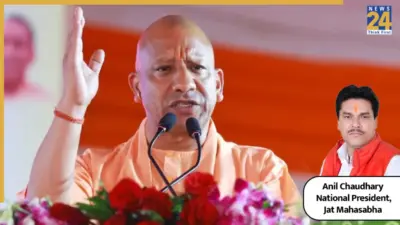

On the 650th birth anniversary year of Sant Ravidas, by renaming Bhadohi as Sant Ravidas Nagar, Uttar Pradesh Chief Minister Yogi Adityanath has further expanded his vision in which he considers renaming essential for cultural restoration and thinks beyond party commitments in this regard.
This is also a matter of pride for Bhadohi because, after receiving the designation of Sant Shiromani Ravidas, this district will now be seen as a pioneer of social harmony. In his time, Sant Ravidas challenged those bonds of caste and varna due to which a large section of society was deprived of opportunities for education and dignity. Naming the district after him symbolizes that the Yogi government, too, is committed not on the basis of caste and varna, but with equality and for the development of all. Not only Sant Ravidas Nagar, but if one looks at all the renamings carried out during the Yogi government with a comprehensive perspective, they reflect reverence for the historical glory of deprived and neglected communities.
In fact, Chief Minister Yogi's effort is not limited to removing Mughal-era or colonial names, but also to preserving in the national memory those unsung heroines and people's heroes who were kept outside the mainstream of history for decades. Take the example of Uda Devi, the heroine of the Pasi community in the First War of Independence of 1857, who displayed indomitable courage against British soldiers at Sikandar Bagh in Lucknow. The Yogi government not only installed her statue in Lucknow but also named a women's PAC battalion after her. Similarly, a women's PAC battalion was established in Agra in the name of Jhalkari Bai, the commander of Rani Lakshmibai's army, who belonged to the Kori (Dalit) community. Battalions were also established in the name of Avanti Bai of the Lodhi community. This sends a message to these communities that the contribution of their ancestors to nation-building is part of the state's official memory. It is a permanent presence of social justice.
Similarly, the Yogi government expanded memorials, tourism projects, and cultural events in the name of Maharaja Suheldev, the pride of the Rajbhar community, creating a new sense of identity among the most backward communities of eastern Uttar Pradesh. Museums and memorial projects were also developed in the name of Birsa Munda, who fought against the British for tribal identity and land rights. Such an example of giving equal dignity to diverse social groups of the state is rarely found elsewhere. A distinctive vision of restoring cultural pride is also visible in several other decisions. Renaming Jalalabad town in Shahjahanpur district as Bhagwan Parshuram Puri, renaming Nagar Panchayat Khiloni-Suchitganj in Ayodhya district as Maa Jwala Ji, Fazilnagar in Kushinagar as Pavagarh, and Bhadarsa as Bharat Nagar are examples of this.
It should be the responsibility of a government committed to national identity to bring forward such symbols that become a source of inspiration for future generations, but this was not seen under previous governments. If one looks at the governments before Yogi Adityanath came to power, their leaders remembered the symbols of Dalit and backward communities only during election seasons. Floral tributes on an anniversary, naming a scheme, then silence, and then waiting for the next election. Even when places were named, it was done to promote leaders of their own political parties for political gain. In contrast, the Yogi government has given them permanent honour by naming institutional structures, police battalions, memorials, museums, roads, and other public infrastructure after them.
If we turn the pages of history, during the Mughal period many major districts such as Ghazipur, Azamgarh, Aligarh, Moradabad, Allahabad, Fatehpur, Firozabad, Shahjahanpur, and Muzaffarnagar were named after Mughal rulers, their commanders, and relatives. Agra was called Akbarabad, and Prayagraj was renamed Allahabad. This was a planned cultural displacement. The restoration of Allahabad as Prayagraj is the greatest source of pride for its people. The land where the sacred confluence of the Ganga, Yamuna, and the invisible Saraswati takes place, where millions of devotees gather every twelve years for the Kumbh Snan, had to bear a name that had no connection with its spiritual consciousness. Under the Yogi government, the soul of this ancient site has returned. Similarly, renaming Faizabad district as Ayodhya Dham is a step towards restoring the true glory of the birthplace of Lord Shri Ram. In Gorakhpur, which is itself Chief Minister Yogi Adityanath's karmabhoomi, he also renamed Urdu Bazaar as Hindi Bazaar, Humayunpur as Hanuman Nagar, Miyan Bazaar as Maya Bazaar, and Alinagar as Arya Nagar. All these changes are efforts to reconnect local identity with its cultural roots.
In fact, people associated with Sanatan faith themselves wish to be freed from names that they believe hurt their identity. Voices have continuously been raised in this regard. For Sambhal district, names such as Kalki Nagar or Prithviraj Nagar have been suggested as an effort to honour the memory of the future incarnation of Lord Vishnu and the valiant ruler Prithviraj Chauhan. There have also been demands by local public representatives to rename Aligarh as Harigarh and Deoband as Devvrindpur. When a society wishes to call its towns by names connected with its mythology, history, or faith, it becomes the responsibility of the state government not to ignore those aspirations. The Yogi government is listening to them.
Opposition parties often argue that this campaign of renaming is an attempt to divert attention from real issues such as education, employment, and healthcare. However, this argument weakens when we see that symbolism and policy are progressing together. Making a community feel that its history is part of the nation's pride builds self-confidence, which in turn encourages active participation in education and employment. A society that realizes its ancestors were not merely spectators standing on the margins, but active participants in nation-building, also moves forward with greater enthusiasm in education and participation in administration.
(Disclaimer: The opinions expressed here belong solely to the author and do not reflect the views of News24, its management, or its staff.)