




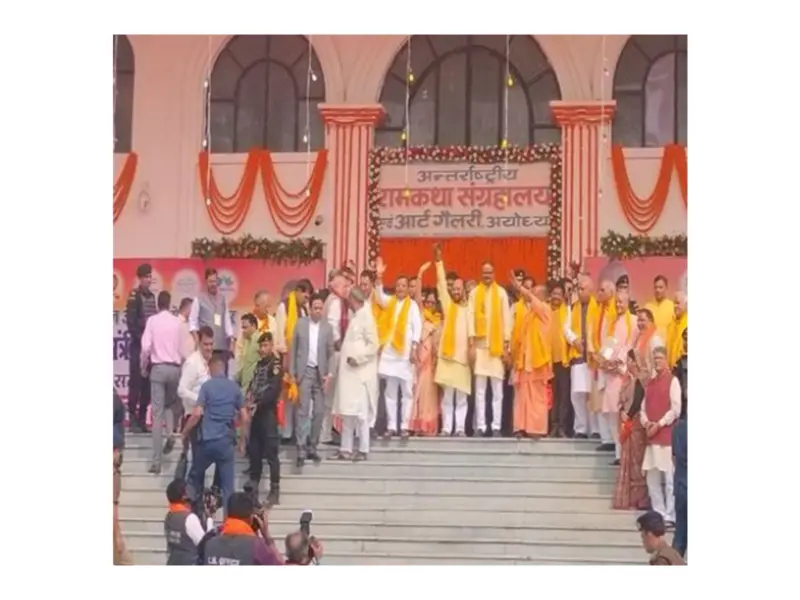

A new museum in Ayodhya, Uttar Pradesh, is entering the final phase of construction, aiming to narrate the story of Lord Ram using 7D technology and Artificial Intelligence (AI).
The museum will recreate key milestones from the Ramayana, including Lord Ram’s childhood and epic battles, through holograms that offer a lifelike experience.
A 7D ‘Hanuman Gallery’ is being developed within the ‘Sankat Mochan Vithika’ (Gallery of the Remover of Troubles), dedicated to Lord Hanuman’s valour. This gallery will feature a 20-minute film with immersive 7D effects showcasing Lord Hanuman’s heroic feats.
Experts from IIT Madras and a technical team from France are collaborating on the technology and scripting for the project. The museum will include 20 galleries portraying pivotal stages of Lord Ram’s life, such as his birth, education, exile (Vanvas), and the conquest of Lanka.
More than 100 ancient artefacts and sculptures, unearthed during the excavation of the Ram Temple site, along with documents connected to the 500-year-old temple movement, will also be exhibited. Additionally, a rare manuscript of the ‘Valmiki Ramayana,’ dating back 233 years, recently gifted to the museum, will be displayed.
While inspecting the museum, Director Sanjeev Kumar Singh stated, “The building designated for the International Ramkatha Museum was originally constructed in the British architectural style. We have since transformed it into the traditional Indian architectural style. Given this, it will become the International Ramkatha Museum, so the primary objective was to ensure that the institution is housed in a structure befitting its stature; consequently, the building’s aesthetic has been designed to reflect that ethos. We have set a target to complete all civil construction works by May 30.”
He added, “Following this, we will commence the display phase–specifically, within our gallery section. We have already completed the work on five display pedestals, while work on additional pedestals is currently underway in the laboratory–specifically, the conservation laboratory. Consequently, we will soon begin the installation process for these as well.”
Singh emphasised that civil engineering work is prioritised to protect sensitive artefacts like manuscripts, textiles, and stone objects from dust before the display setup begins. “Since the collection comprises sensitive artefacts–including manuscripts, textiles, and stone objects–it is crucial to protect them from dust particles, which can cause irreparable damage. To safeguard against this, we decided to complete all civil engineering works first before initiating the display setup. We are confident that, very soon, Ayodhya will be able to proudly declare to the entire world: ‘We, too, possess a museum–one that is truly unique.'”
He added that the museum will be a unique global attraction featuring 7D technology, which is a first-of-its-kind initiative worldwide, to provide visitors with an immersive experience. “Furthermore, we are incorporating cutting-edge technology into this project. We have introduced 7D technology–a pioneering initiative not just in India, but globally. No other museum in the world has utilised 7D technology in this manner before; we are implementing it within our museum, and it promises to be a truly unique experience in its own right,” he said.
Singh further explained, “We have named this 7D technological experience ‘Sankat Mochan.’ This ‘Sankat Mochan’ will, in a sense, serve as our own saviour as well, for it is through his grace and narrative that this epic tale unfolds. Given that ‘Sankat Mochan’ is his very name–meaning the ‘Remover of Troubles’–his glory and renown will be further illuminated, as we have chosen him as the central protagonist of this immersive experience.”