
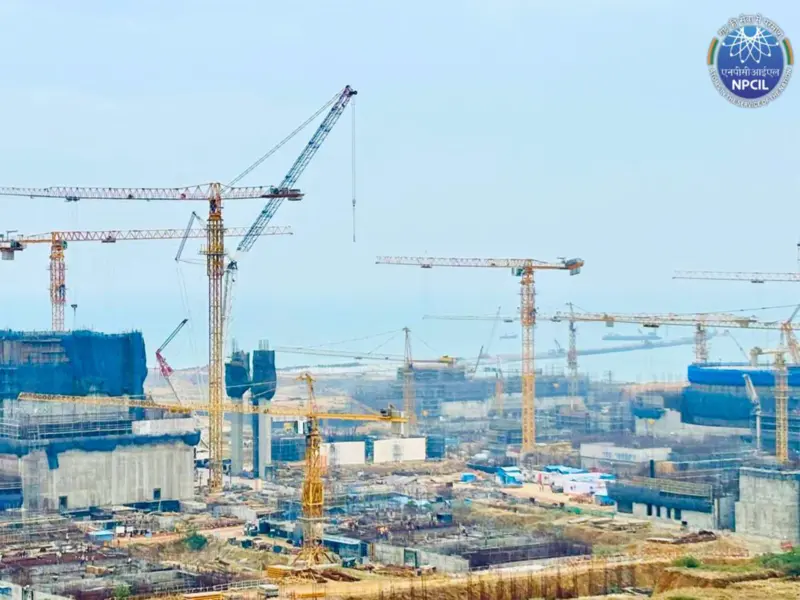

The Atomic Energy Regulatory Board (AERB) has granted permission for the erection of major equipment at Units 5 and 6 of the Kudankulam Nuclear Power Project in Tamil Nadu, the Nuclear Power Corporation of India Limited (NPCIL) announced.
In a statement posted on X, NPCIL described this approval as a key milestone in India's nuclear energy programme, stating that Kudankulam Units 5 and 6 reflect the nation's commitment to safe, clean, and reliable power.
"Landmark progress at Kudankulam…India's nuclear energy programme achieves another decisive milestone. The Atomic Energy Regulatory Board (AERB) has accorded permission for major equipment erection at Units 5 & 6 of Kudankulam Nuclear Power Project (KKNPP)," the post read.
The clearance permits NPCIL to install critical components including the reactor pressure vessel, steam generators, and coolant pumps, advancing the project towards completion.
Officials reported that the decision followed a thorough multi-tier safety review by the AERB, which assessed reactor design and construction progress, ensuring compliance with national regulations and international standards such as those set by the International Atomic Energy Agency.
The regulator issued the permission on April 30 after reviewing safety requirements and civil construction progress based on an earlier approval granted in April 2021 for the "First Pour of Concrete" stage.
The new units incorporate advanced safety features aligned with AERB's safety code for light water reactor-based nuclear power plants.
The Kudankulam project, located in Tirunelveli district, comprises six pressurised water reactors of the VVER (Water-Water Power Reactor) design, developed in technical collaboration with Russia. Each unit has a capacity of 1,000 MW.
Units 1 and 2 have been operational since 2013 and 2015 respectively, while Units 3 and 4 are at an advanced stage of construction. On April 28, Unit 3 moved closer to commissioning with the commencement of "spillage to open reactor," a process to flush and clean coolant systems ahead of operation.
NPCIL stated that Units 1 and 2 have collectively generated over 121 billion units of electricity, helping to avoid nearly 104 million tonnes of carbon dioxide emissions. When all six units are complete, the plant will have a total installed capacity of 6,000 MW.
India's civil nuclear cooperation with Russia remains a significant element in expanding capacity. External Affairs Minister S Jaishankar remarked, "Russia is our foremost partner in civil nuclear energy and the Kudankulam nuclear project is a stellar example. As India aims to increase its nuclear energy generation capacity to 100 gigawatt by 2047, I am confident that it will find a trusted and reliable partner in Russia for peaceful uses of nuclear energy."
The Kudankulam project was also discussed during Russian President Vladimir Putin's visit to India in December last year. The Russian President said, "We're conducting a flagship project to build the largest Indian nuclear power plant, Kudankulam. Two out of six reactor units have already been connected to the energy network, and four are still under construction. Getting this nuclear power plant to full power output will make an impressive contribution to the energy requirements of India."