




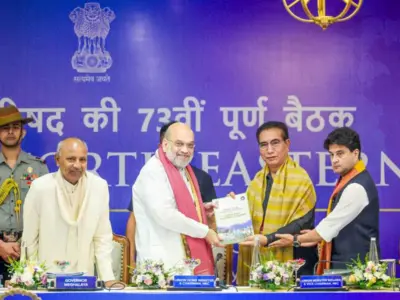

Union Home Minister and Minister of Cooperation, Amit Shah, chaired the 73rd Plenary Session of the North Eastern Council (NEC) in Shillong, Meghalaya, on Thursday, January 31, 2026. The session was attended by Union Minister for Development of North Eastern Region (MDoNER) Jyotiraditya Scindia; Governor of Meghalaya C.H. Vijayashankar; Chief Minister of Meghalaya Conrad Sangma; Union Minister of State for Development of North Eastern Region Sukanta Majumdar; Union Home Secretary Govind Mohan; Secretary, Ministry of Development of North Eastern Region Sanjay Jaju; as well as the Governors and Chief Ministers of Arunachal Pradesh, Assam, Manipur, Tripura, Mizoram, Nagaland, and Sikkim, alongside other dignitaries.
Addressing the meeting, Shah said that under the leadership of Prime Minister Narendra Modi, focused development efforts have accelerated the progress of the North East over the past 12 years, resulting in significant qualitative transformation in all states of the region. He noted, “Apart from PM Modi, there has perhaps been no Prime Minister who has worked with such sustained focus and commitment towards the development of the North East.” Shah emphasised that development rests on pillars of good law and order and social harmony, highlighting that more than 12 peace accords have been signed over this period and over 10,800 youth have returned to the mainstream after laying down arms.
Shah stated that insurgency has been eradicated and infrastructure development has advanced substantially, with improved rail, road, and air connectivity reducing distances between Delhi and the North East. He added that Prime Minister Modi has bridged both geographical and emotional distances between the region and the rest of the country through a Whole-of-Government Approach. Shah said the North East’s diversity has become a global strength, and the region is now recognised as an opportunity hotspot, transitioning from a past associated with conflict to one of coexistence and harmony.
He described it as a collective responsibility to preserve the region’s rich diversity, which comprises over 200 tribal groups, more than 195 dialects, and a wide array of cultures, cuisines, and traditional attire. Shah urged revitalising this shared cultural heritage to realise Prime Minister Modi’s vision of Ashtalakshmi on the ground. He asserted that principles of “Act East, Act Fast, and Act First” have been successfully implemented, and that the region has been supported through focused planning and monitoring rather than budgetary allocations alone.
Shah referred to the High-Level Task Force report on the development, prosperity, and cultural preservation of the North East as a guiding document. He encouraged states to utilise all budgetary provisions fully and strive for complete implementation of the report’s recommendations, stating that future priorities should be shaped accordingly. He noted that the Rising North East Investment Summit would enable all eight states to benefit from ancillary industries linked to major industrial investments, citing Rs 4.25 lakh crore of investments attracted after Assam’s Investment Summit.
Highlighting key projects, Shah mentioned a semiconductor plant in Assam worth around Rs 27,000 crore, the development of the North East as a healthcare hub for the region and neighbouring countries, and the Namrup Ammonia-Urea Complex aiming to reduce logistics costs. He stressed the need for monthly monitoring of the Single Window Clearance mechanism by Chief Ministers and Governors, and the timely completion of multimodal logistics hubs in Guwahati, Imphal, and Agartala.
Shah encouraged all North Eastern states to achieve self-reliance in fish, egg, and milk production, supplying surplus to other parts of India. He noted the dairy sector’s importance in prosperity and announced a target of supplying over 50,000 milch animals annually through the National Dairy Development Board (NDDB) from the next financial year, alongside creating a cooperative framework for milk collection and marketing.
Improving connectivity, promoting integrated urbanisation, and developing 15 high-potential sectors must remain key focus areas, Shah added. He highlighted the importance of water resources and natural wealth in development and urged that the NEC evolve into a strategic planning institution rather than a mere fund distributor. Shah outlined plans to enhance regional cooperation and human resource utilisation via connectivity through West Bengal and the Sabroom Land Port, opening gateways for trade with Southeast Asia and the Indo-Pacific region.
Addressing cultural preservation, Shah stressed that losing any of the region’s languages or dialects would be a significant national loss. He called on states to work diligently to preserve the North East’s unique identity as a source of strength. Shah indicated that under the PM-DevINE scheme, cluster projects worth Rs 65 crore have been approved in Assam and Tripura and should serve as model initiatives. He noted around 215 crops and products from the region seek Geographical Indication (GI) tags and encouraged states to form task forces to monitor the process.
Shah said the North East is ideal for the Healing India Mission and urged states to develop policies for wellness infrastructure and health tourism, tapping into natural advantages and traditional knowledge. He further announced that civilian casualties in the North East have declined by 86 percent over 12 years under the Modi Government due to over 12 historic peace accords fostering a positive environment.
He explained that the Government of India has designed a special plan to eradicate narcotics transportation and consumption in the region. Shah urged Chief Ministers to raise citizens' awareness of constitutional rights and to protect these rights, noting that insurgency has mostly been eliminated. He advocated for improvements in routine policing, prioritising the protection of the rights of the poor, women, and children.
Shah called for timely justice under the new Nyaya Sanhita, greater use of technology in the criminal justice system, higher conviction rates through forensic science, and comprehensive frameworks including online case registration and testimony to ensure rights and justice for all citizens. He highlighted the potential of North Eastern youth in digital skills such as Artificial Intelligence, Data Analytics, Machine Learning, and Blockchain and promoted transforming the region into a major IT hub.
He emphasised the region’s immense hydropower and solar energy resources for sustainable economic growth and stressed attracting data centres by aligning education, industrial development, and long-term natural resource utilisation to create a foundation for a technology-driven economy.