
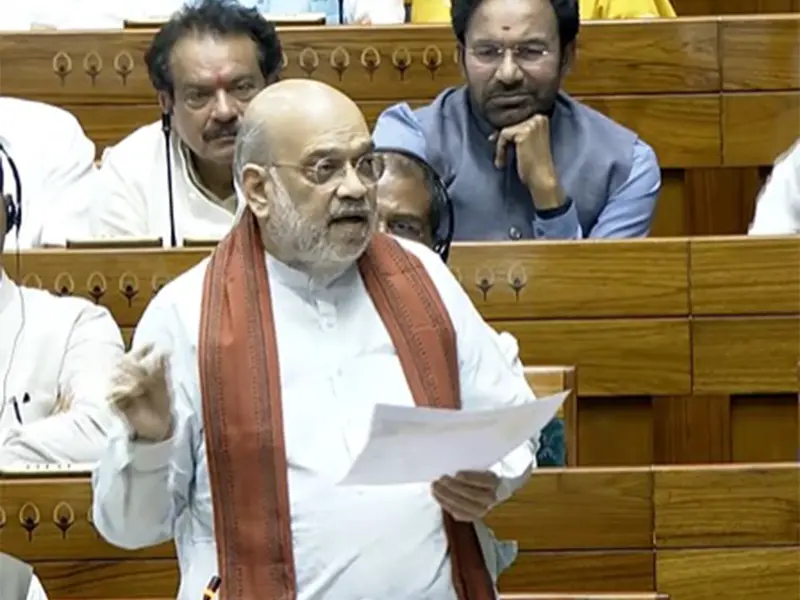

Union Home Minister Amit Shah criticised opposition parties on April 18 for their position on the Delimitation Bill and other legislation concerning early implementation of women's reservation.
He stated they will face the anger of women not only in the 2029 Lok Sabha elections but at all electoral levels and locations.
Responding to a two-day debate in the Lok Sabha on the Delimitation Bill, 2026; the Constitution (131st Amendment) Bill, 2026; and the Union Territories Laws (Amendment) Bill, 2026, Shah emphasised that the aim is to apply the principle of “one person, one vote, one value” as established by the Constituent Assembly, which forms the basis of India’s democracy.
Shah explained that the Constitution provides for delimitation periodically, increasing seats for Scheduled Castes and Scheduled Tribes, and that opposing delimitation equates to opposing their increased representation. He asserted that the government, under Prime Minister Narendra Modi, bears the responsibility to create a balanced, inclusive and effective democratic structure.
He added that delimitation maintains federal balance, proportionate representation in the Lok Sabha, and state power equilibrium. It also reflects geographical and administrative changes, urbanisation, connectivity improvements, and the formation of new districts. These principles are enshrined in Articles 81, 82, and 170 of the Constitution, forming the basis for the government’s constitutional amendment proposals.
The Nari Shakti Vandan Act mandates women’s reservation in delimitation following the Census after 2026. Shah noted that seat numbers have been frozen since 1971, resulting in 127 constituencies with over two million voters each. He recalled that in 1976, during the Emergency, the 42nd Amendment halted delimitation, which he attributed to the then principal opposition party depriving the country of this process, a situation he said persists today.
He further detailed that the 84th Amendment in 2001 froze the number of seats until 2026, causing a 50-year gap without representation proportional to population growth. Shah explained that even if delimitation begins in 2026, it cannot conclude before 2029 due to required public hearings.
Highlighting demographic changes, Shah mentioned that India’s population has grown from 54.79 crore in 1976 to 140 crore today. He proposed increasing the number of seats in every state by 50 percent to maintain proportionality, while also increasing the number of parliamentary working days.
On the Census delay, Shah stated that the 2021 Census was postponed due to COVID-19 and resumed in 2024, incorporating caste enumeration after consultations with stakeholders. He rejected claims of creating North-South divisions, affirming equal rights for southern states and denouncing attempts to cause regional discord.
He cited that Karnataka, Andhra Pradesh, Telangana, Tamil Nadu, and Kerala collectively hold 129 seats (23.76 percent of Lok Sabha seats). After a 50 percent increase in seats, these would rise to 195, preserving their share at 23.87 percent if the total seats increase to 816.
Shah accused Congress of opposing the interests of Other Backward Classes (OBCs). He referred to the shelving of the Kaka Kalelkar Commission recommendations in 1957 and the Mandal Commission report’s delay until 1990 under VP Singh’s government, despite opposition from senior Congress leaders. He also stated Congress opposed caste-based censuses in 1951 and 1971.
He added: “For the opposition, winning elections is paramount, but for the government, the nation and its people come first.” Shah insisted that the public recognises the opposition’s superficial concerns and that women are aware of the opposition’s deprivation of their rights.
He recalled that the 72nd and 73rd Constitutional Amendments in 1992 provided 33 percent reservation for women in Panchayats. From 2008 to 2014, Manmohan Singh introduced the 108th Constitutional Amendment Bill, which was passed in the Rajya Sabha but not in the Lok Sabha.
Shah noted that the first Bill passed unanimously in the new Parliament building was the Nari Shakti Vandan Act, also passed in the Rajya Sabha. He highlighted the increasing presence of women in the Lok Sabha, from 22 members in the first session to a record 78 in the seventeenth and 75 in the eighteenth Lok Sabha, reflecting growing female political engagement.
He stressed that the government follows the principle of “women-led development” in women’s reservation, with approximately 1.4 million women serving as elected Panchayat representatives. Shah affirmed they will continue striving to empower women despite opposition.
Shah concluded that Congress opposes all government measures and that opposition leaders will face the anger of the country’s women during elections.
The Constitution (131st Amendment) Bill, 2026, was subsequently defeated in the House. The government decided not to pursue the Delimitation Bill, 2026, and the Union Territories Laws (Amendment) Bill, 2026, stating these three bills are interlinked. The bills were discussed together.