




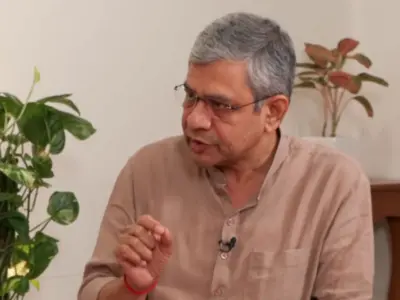

Union Minister Ashwini Vaishnaw praised the development and inclusive growth achieved by the Narendra Modi-led government as it completed 12 years in office.
Speaking on Monday, Vaishnaw contrasted this administration’s approach to governance with that of previous governments, stating, “For the entire country, it’s a great moment because for decades we have had governments which were not so sensitive towards people’s needs. In the last 12 years, people have seen a new form of governance, people have seen that sensitivity, people have seen that care for the people and the people at the bottom of the pyramid, people with the lowest incomes, they have seen a change in their lives.”
He emphasised the government's work at the grassroots level, mentioning efforts such as the construction of toilets and houses, the creation of Jan Dhan accounts, and the provision of basic infrastructure including roads and electricity. Vaishnaw described these measures as among the Centre’s most impactful achievements, stating, “If you look at the journey of the last 12 years, the change in people’s lives which has happened. At the grassroots level, that is really visible. Look at the way toilets brought dignity to women. Look at the way financial inclusion happened. More than 54 crore accounts have been opened under the Jan Dhan Yojana. All those people today have access to investment opportunities, access to loans, and access to savings instruments. That thing has entirely changed. Look at the number of houses which have been constructed. 4 crore houses, more than 4 crore houses constructed in the entire country. Look at the way every village has got the basic facilities like good roads and electricity connections. All these things have really made a big difference in people’s lives.”
Prime Minister Narendra Modi first took office on May 26, 2014, and has since been sworn in for two consecutive terms in 2019 and 2024. Over the past 12 years, the government’s development strategy has increasingly focused on strengthening public welfare and expanding access to essential services for farmers, the poor, and the middle class.
Initiatives across sectors such as agriculture, healthcare, housing, digital payments, and financial assistance aim to ensure that progress reaches people at the grassroots level. The effects of welfare schemes and technology-driven governance are becoming more apparent in daily life in both rural and urban areas. Farmers receive direct financial support, low-income families access social security and healthcare, and digital services facilitate quicker and easier transactions.
Currently, more than 80 crore people benefit from free food grain distribution under welfare programmes intended to ensure food security. Housing efforts have provided over 4 crore families with permanent homes, while the Ujjwala Yojana has supplied LPG connections to more than 10 crore women, reducing reliance on traditional cooking fuels.
India’s middle class is experiencing rapid transformation through digitalisation and tax reforms. The changing landscape affects farmers, small entrepreneurs, patients, and middle-class families alike, reflecting a broad commitment to inclusive governance and improved service delivery.