


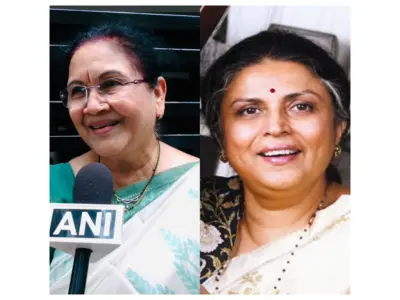

Marathi author Mangala Khadilkar, who wrote the biography 'Suman Sugandh' on the late singer Suman Kalyanpur, paid tribute to the artist's humility, musical sensitivity and lasting influence on Indian music.
Khadilkar described feeling privileged to document Kalyanpur’s life and career, stating, “My name is Mangala Khadilkar. I am fortunate that I was able to write about her.” She recalled the difficulty of gathering information for the biography, saying, “Because that biography was written when YouTube was not there, Google was not there. People had very little knowledge about her because she was a very quiet person.”
The author noted that Kalyanpur seldom spoke about herself but eventually opened up during their conversations: “But we forced her to break her silence. So she broke her silence. At that time, all rasiks and all of us were very happy. There are many stories.”
Khadilkar highlighted Kalyanpur’s meticulous attention to detail in her singing, recalling a recent performance of one of her songs where, “she had sung that particular word so softly. There is a beauty in the expression of a young couple. That is how that word comes. She used to sing every word with a lot of thought. That is why her songs were different.” She emphasised that no other singer’s style was comparable, adding, “Her songs were different. They were her own songs.”
Describing Kalyanpur’s artistic essence, Khadilkar said, “In Marathi, we say ‘Apna Komal Aatmabhaan’. In Hindi, I would say there was a softness of nature, a softness of voice and a softness of singing style. All three were present in her.” She added, “So whatever was created with the combination of all three was so beautiful that there are no words for it.”
The author recalled a poignant moment from Kalyanpur’s final days when a song linked to her musical training was played beside her hospital bed. “When we kept a mobile phone near her bed and played that song, we asked, ‘Suman Tai, who sang this song? Who composed this song?’ It was very difficult for her to speak,” Khadilkar said.
However, Kalyanpur responded promptly when asked about her guru. “But when it came to her guru, she opened her eyes and looked at us for a moment. She said, ‘Guru Abdul Rehman Khan,'” Khadilkar added. She described the moment as deeply moving, reflecting the singer’s enduring reverence for her teachers and music. “At that time, the gratitude towards the guru and the gratitude towards music was completely filled within her,” the author stated.
Khadilkar concluded by recognising Kalyanpur’s significant legacy in Indian Bhaavsangeet and film music. “Our Indian Bhaavsangeet has reached great heights. Whatever she has left behind through her singing is a heritage of immense value,” she said. Drawing a connection across generations, she remarked, “We sing songs of Lataji and Ashaji, and the next generation will sing songs of Suman Tai. That is the beauty of it.”
Suman Kalyanpur, celebrated as one of India’s most respected playback singers, is remembered for her soulful voice and timeless melodies cherished across generations. She was laid to rest with full state honours in Mumbai following her death at the age of 89. Her last rites took place at the Santacruz (Pawan Hans) crematorium.
Condolences were extended nationwide. Prime Minister Narendra Modi expressed sorrow over Kalyanpur’s passing, acknowledging her “melodious voice and soulful renditions” that left a lasting impact on Indian music and cinema. In a statement on X, he said, “Anguished by the passing of the popular singer Suman Kalyanpur Ji. Her melodious voice and soulful renditions enriched our cultural world. Through her songs, she created a special place among music lovers and admirers of Indian cinema.”
The Prime Minister also offered his sympathies to her family, friends and admirers, concluding with, “Condolences to her family and admirers. Om Shanti.” Other union ministers, political leaders and members of the cultural community also paid respects, acknowledging her enduring contribution to Indian cinema and music.
Kalyanpur enjoyed a distinguished career from 1954 to 1988, establishing herself as a revered playback singer whose versatile voice graced songs in multiple languages.