
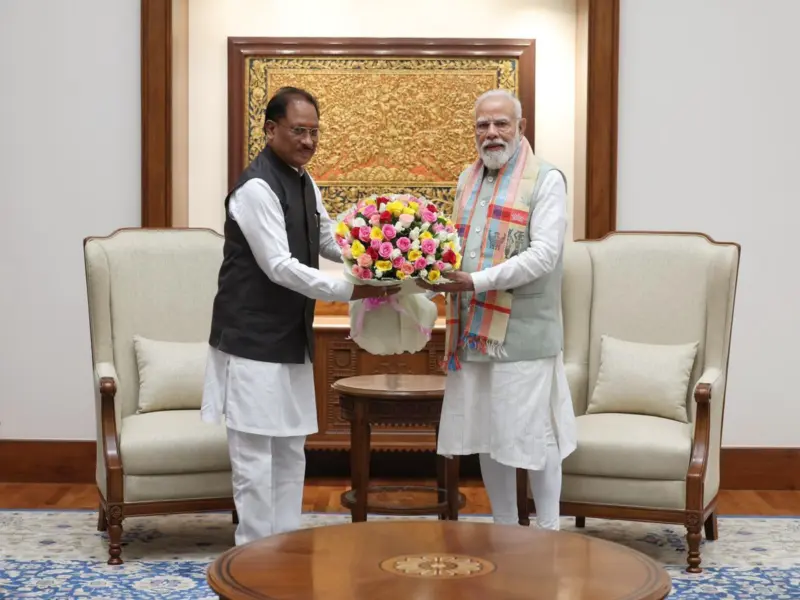

Chhattisgarh Chief Minister Vishnu Deo Sai met Prime Minister Narendra Modi on Tuesday to present a comprehensive vision for Bastar's next phase of development.
The Chief Minister acknowledged the restoration of peace in the region following the decline of Naxalism, crediting the Prime Minister’s leadership and support.
Mr Sai shared a detailed blueprint focused on driving holistic growth in Bastar, emphasising tourism, start-up ecosystems, infrastructure expansion, and innovation-led development. The plan outlines a transformative roadmap designed to accelerate economic progress and enhance the quality of life.
He invited the Prime Minister to visit Bastar after the monsoon season, with plans for laying the foundation stones of several major projects and inaugurating key initiatives in his presence. This visit is expected to mark the beginning of a new growth era for the region.
The Chief Minister highlighted that Naxalism has been eliminated across Chhattisgarh, including Bastar, paving the way for lasting peace. He emphasised major strides in education and healthcare, including new Education Cities, super-speciality hospitals, and medical colleges. Connectivity is being strengthened through infrastructure projects such as barrages on the Indravati River, railway network expansion, and airport development.
Mr Sai stated that the blueprint aims to generate employment and improve access to essential services. He noted that transforming Bastar into a hub of peace and progress, envisaged by the Prime Minister nearly a decade ago, is now taking shape. The end of Naxalism has replaced fear with optimism and renewed confidence among the people.
The development plan is based on the strategy “Saturate, Connect, Facilitate, Empower, and Engage,” focusing on rapid, inclusive expansion of infrastructure and services, especially integrating remote villages via a robust road network. Pending works under the Pradhan Mantri Gram Sadak Yojana are to be completed by 2027, with 228 new roads and 267 bridges planned. Additionally, 61 new project proposals have been submitted for special central assistance to accelerate development.
Significant advancements are also planned in energy and social infrastructure sectors. Efforts will intensify to achieve universal electrification. Forty-five existing ‘Pota Cabin’ schools will be upgraded to permanent buildings, while 15 stadiums and two multi-purpose halls are proposed for youth development. Healthcare will see expansion of Primary Health Centres and construction of transit hostels for doctors to improve service accessibility in remote areas.
Two major irrigation projects on the Indravati River at Deurgaon and Matnar have been sanctioned, expected to cover nearly 31,840 hectares of land. This will strengthen Bastar’s agricultural base and improve farmers’ productivity and income.
A focused three-year plan aims to double household incomes by raising the monthly earnings of nearly 85% of families from Rs 15,000 to Rs 30,000 by 2029, enhancing economic stability. The ‘Niyad Nellanar 2.0’ initiative is expanding from 10 districts to include seven existing and three new districts: Gariaband, Mohla-Manpur-Ambagarh Chowki, and Khairagarh-Chhuikhadan-Gandai, promoting inclusive and balanced regional development.
The Chief Minister also introduced a dedicated Startup Policy under the ‘Anjor Vision 2047’ and ‘Viksit Bharat@2047’ initiatives, aiming to nurture 5,000 start-ups by 2030. The policy intends to foster innovation, entrepreneurship, and new economic opportunities.
In tourism, key destinations such as Chitrakote and Tirathgarh Waterfalls and Kanger Valley National Park are being developed with improved infrastructure and visitor facilities. Adventure tourism projects, including a canopy walk and a glass bridge, are underway to attract more tourists. Cultural and sporting events like the ‘Bastar Olympics’ and ‘Bastar Pandum’ are helping reshape the region’s identity, while skill development efforts have trained over 100,000 youths, with nearly 40,000 employed so far.
The ‘Bastar Munne’ (Pioneering Bastar) initiative forms a cornerstone of the action plan for a Naxalism-free, rapidly developing Bastar. Under this programme, camps will be organised in every Gram Panchayat to ensure last-mile delivery of government services, issuing essential documents and addressing grievances directly with officials.
Several key projects are slated for foundation laying and inauguration during the Prime Minister’s anticipated visit. These include the Raoghat-Jagdalpur railway line, expansion of Jagdalpur Airport, a Super Speciality Hospital, a Medical College in Dantewada, and the development of Education Cities in Jagargunda and Orchha. These projects are expected to significantly strengthen Bastar’s education, healthcare, and connectivity infrastructure, accelerating growth and regional transformation.